

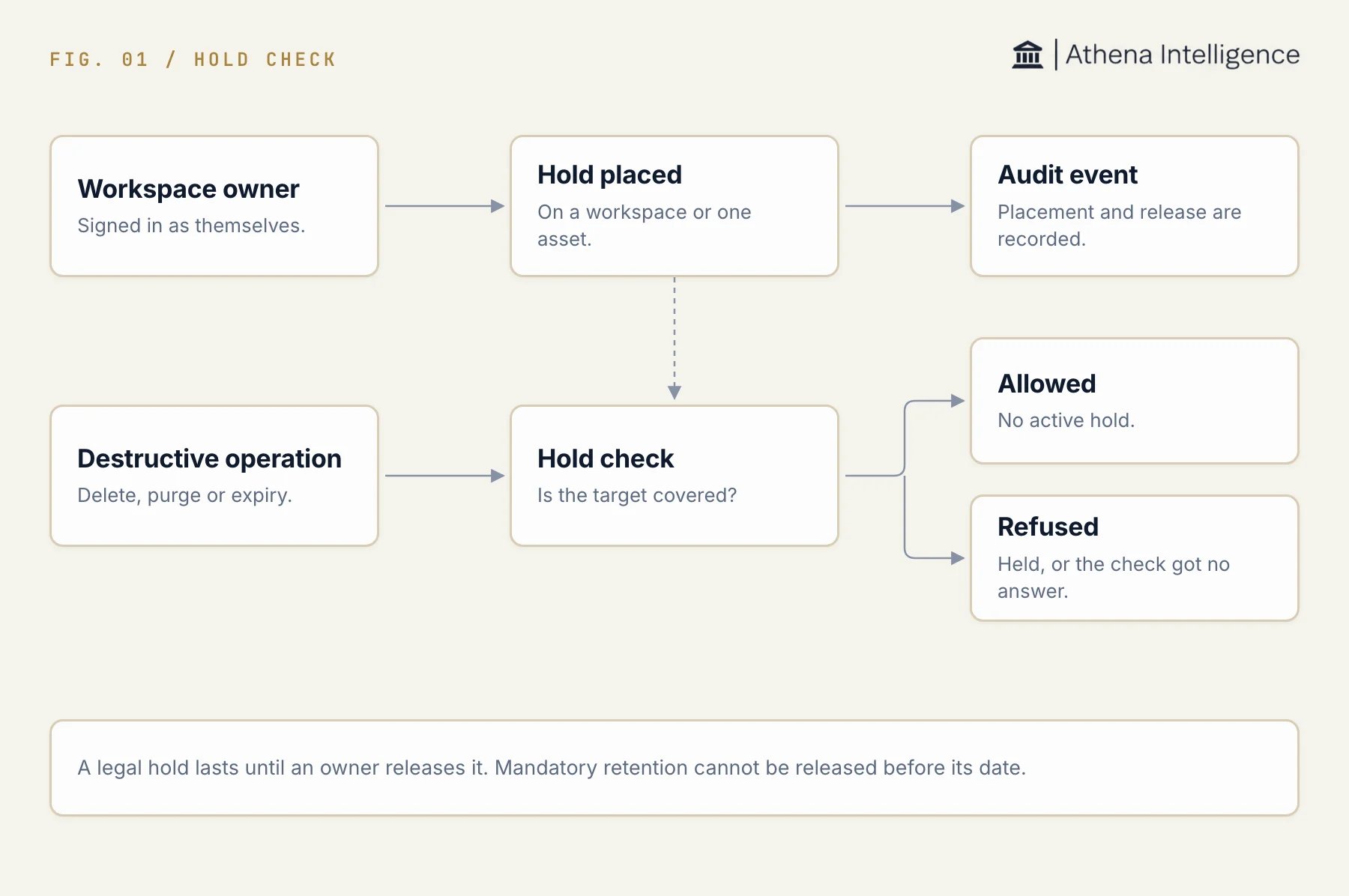
A destructive operation asks the hold check first. A held or unanswered check refuses it.
Choose the scope and kind
A hold on one asset also prevents a purge that would destroy the whole workspace containing it. Folders, projects, and collections cannot receive an asset hold because a hold on those containers does not extend to their contents.
Reaching a mandatory retention date permits release. It does not release the hold automatically.
Who can place and release holds
You must be a signed-in person with a live owner membership in the target workspace. Administrator status alone does not grant this authority. By default, API keys are refused, including an owner’s API key. A deployment’s decision-authority policy can admit an owner’s key for these decisions; ask Athena support how yours is set. Agent and Automation credentials, impersonation and view-as access cannot place or release holds. Athena has no screen for managing holds yet. A workspace owner places and releases holds through Athena’s administrative API, which is not part of the public API reference or the SDKs. Contact Athena support for the procedure.Arrange a hold
- Identify the workspace and decide whether the hold covers the whole workspace or one asset.
- Choose a legal hold or mandatory retention and record the reason.
- For mandatory retention, choose the release-not-before time and its time zone.
- Contact Athena support for the administrative API procedure, then act as the signed-in workspace owner.
- Read back the recorded hold and the enforcement state before relying on it.
Read back enforcement
After a hold is placed, the owner can list the workspace’s holds, including released ones, and read back how deletion is answered for the target. The readback shows hold identifiers and reason codes. It does not show the hold’s reason text.
Some destructive operations, such as a workspace purge, depend on a deployment setting. Ask Athena support to confirm the readback for your deployment before you rely on a hold.
Understand the limits
Covered retention jobs preserve records such as conversation checkpoints, database query history, and Computer restore points. A cross-workspace asset move also checks holds and is refused unless its checks allow it. Archiving is a reversible operation and does not ask the hold check. A hold is not a general freeze on editing. A hold on a database asset does not intercept SQL writes or deletes of individual rows inside the database. Arrange any application-level record preservation separately.Release a hold
- Confirm that release is appropriate and that any mandatory retention date has passed.
- Use the administrative API procedure as a signed-in workspace owner and provide a release reason.
- List the holds with released entries included to verify the release record.