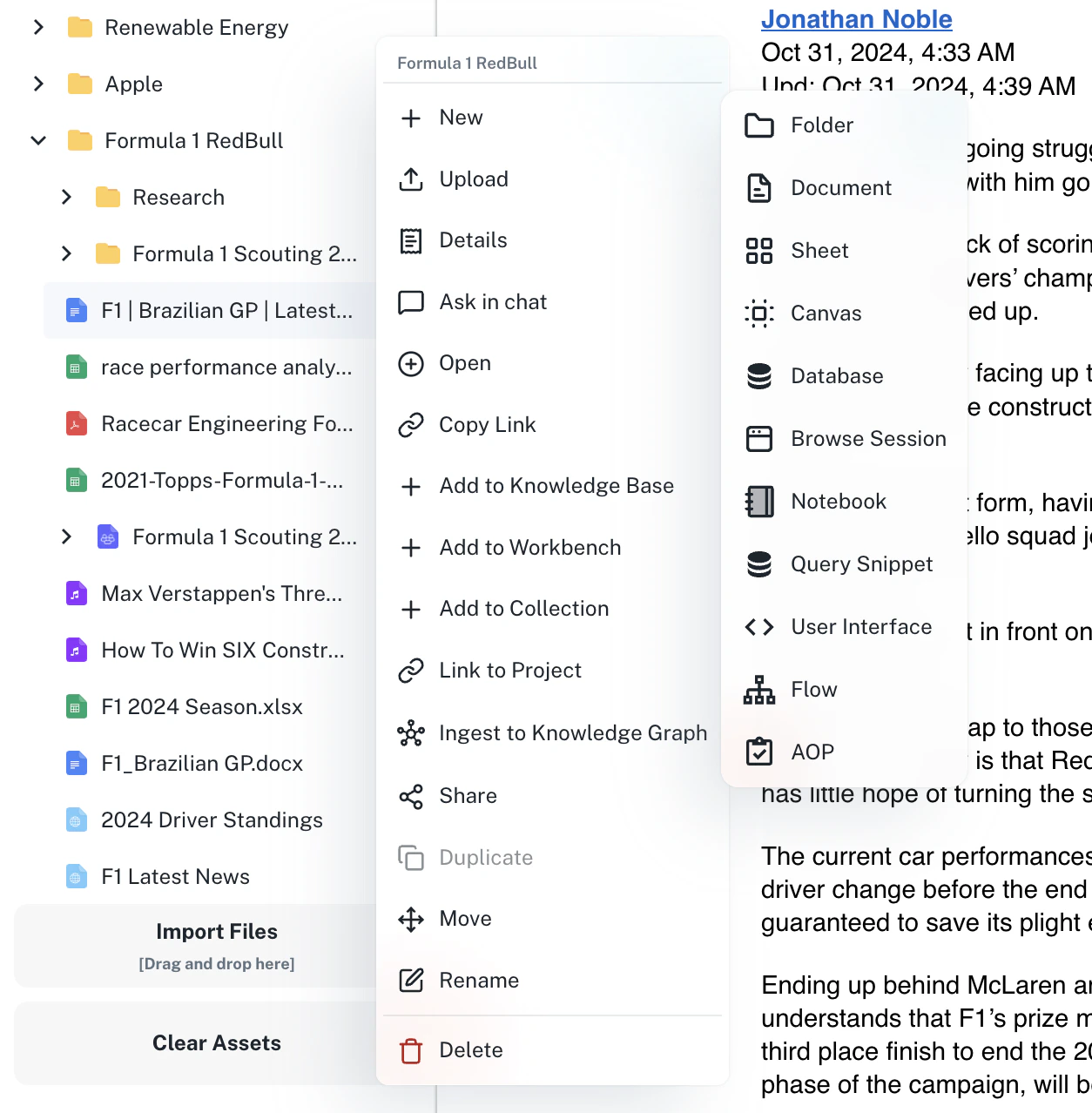
Understanding Assets
Assets are the building blocks of your work in Athena. An asset can be any file, document, or resource that you work with—from documents and spreadsheets to emails, meeting recordings, and data from external sources.Types of Assets
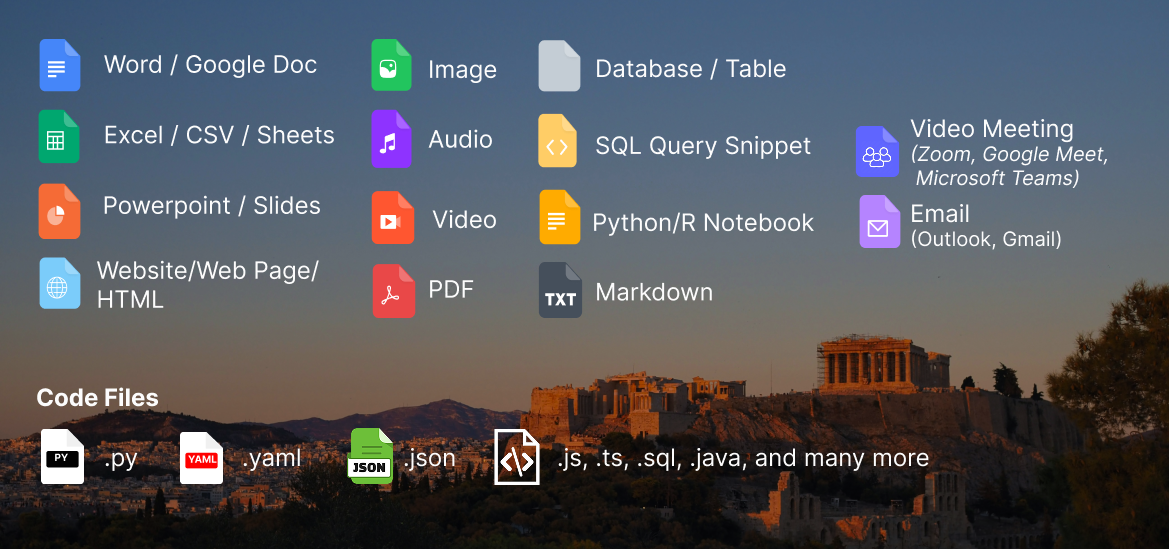
Athena supports a wide variety of asset types:Regular Assets vs Live Assets
Understanding the distinction between regular assets and Live Assets is crucial for effective workflow management:Regular Assets
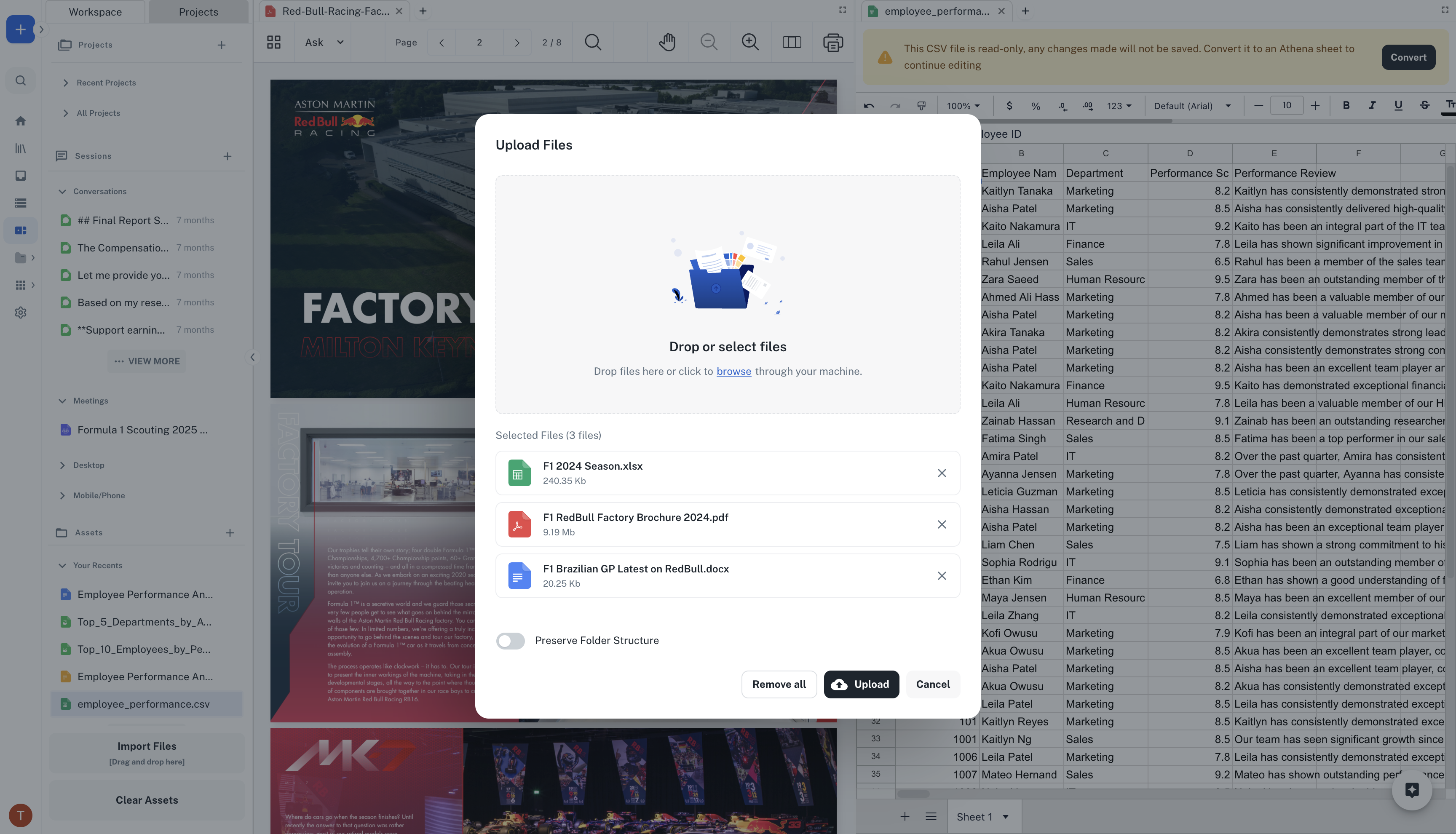
Regular assets are files that you upload directly to Athena:
- Uploaded directly to Athena’s secure storage
- Static content that doesn’t change unless explicitly updated
- Permanently stored with dedicated storage keys
Live Assets
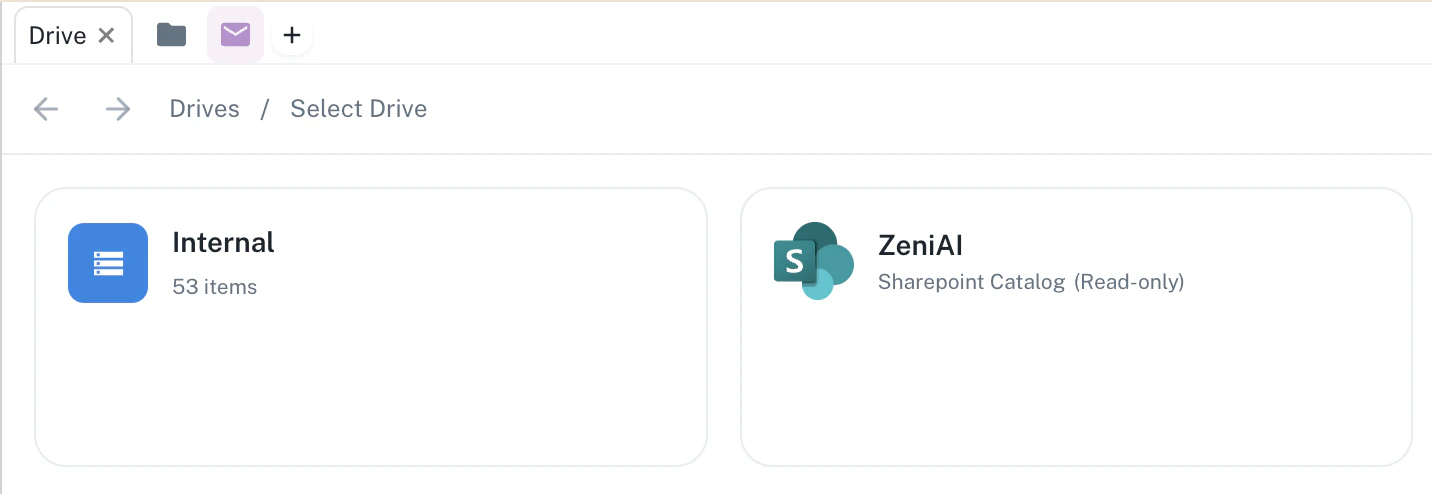
Live Assets are external files and folders from third-party providers that are dynamically integrated into Athena, providing real-time access to your organization’s data without requiring migration or duplication.Unlike traditional assets that are uploaded and stored within Athena, Live Assets remain in their original systems—such as SharePoint sites, Gmail inboxes, Google Drive folders, and other enterprise platforms—and are accessed on-demand through secure API connections.How Live Assets Work
Live assets use a special identifier format that combines the catalog ID with the external file ID:This allows Athena to:
- Fetch files on-demand from the provider
- Cache content for performance
- Maintain references without permanent storage
- Update automatically when external files change
Live asset catalogs are perfect for accessing company files stored in SharePoint or Google Drive without duplicating them into Athena.
Asset Versioning
Asset versioning allows you to create named snapshots of your collaborative documents at specific points in time. Think of versions as “save points” that you can return to whenever needed, providing a safety net for experimentation and collaboration.Key Capabilities
Versioning enables you to tag important milestones in your work with descriptive names, restore documents to any previously saved version, and track who created each version and when. This is particularly valuable when multiple team members are collaborating on the same asset, as it allows you to experiment freely knowing you can always revert to a known-good state.How It Works
When you create a version, Athena captures a complete snapshot of your document’s current state. Each version is stored separately from the live document, ensuring that your version history remains intact even as you continue editing. Versions are read-only snapshots, meaning they cannot be accidentally modified.To restore a version, simply select it from the version history panel. The system will replace the current document content with the selected version’s content, and all connected collaborators will see the update in real-time.Supported Asset Types
Versioning works with all collaborative asset types including spreadsheets, documents, AOPs, and user interfaces. Any asset that supports real-time collaborative editing automatically supports versioning.Create versions before making significant changes to your documents. This gives you a reliable rollback point if the changes don’t work out as expected.
Working with Multiple Assets
Spaces excels at managing multiple assets simultaneously in a flexible, multi-pane view that adapts to your workflow. This powerful feature allows you to reference information across assets, perform comparative analysis, and maintain context across different types of content.You can open various asset types together in Spaces to create a comprehensive workspace:To open assets:
- Browse the sidebar on the left side of Spaces
- Navigate through the Assets section to find documents, spreadsheets, emails, browse sessions, and other content
- Click on any asset to open it in the main Spaces view
- Each asset opens in its own pane within the workspace
- Continue clicking additional assets to add more panes to your workspace
Customize your layout with intuitive drag-and-drop functionality:Rearranging panes:
- Drag tabs - Click and hold on an asset’s tab (at the top of its pane) and drag it to reposition
- Drop on edges - As you drag, drop zones will appear on the edges of existing panes
- Resize panes - Hover over the divider between panes until you see the resize cursor, then click and drag to adjust pane sizes
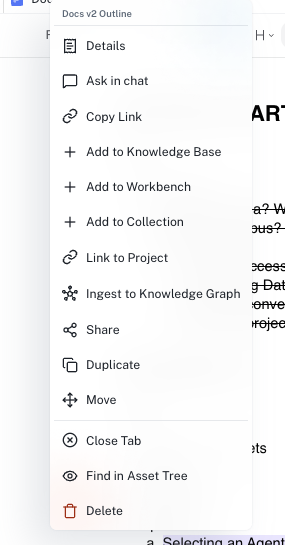
- Close tabs - Click the ‘X’ button on a tab or right-click and select “Close Tab” when you’re done with an asset
Layout possibilities:
- Side-by-side: Compare two documents or reference one while editing another
- Grid layout: View 3-4 assets simultaneously in a grid pattern
- Stacked: Vertical arrangement for viewing multiple assets in sequence
When you have multiple assets open in Spaces, Athena becomes aware of all visible content and can:
- Reference all visible assets in her responses without needing to explicitly mention each one
- Cross-reference information between documents - for example, pulling data from a spreadsheet while writing a document
- Apply insights from one asset to another - such as using research from a browse session to update a report
- Perform comparative analysis across datasets - comparing different spreadsheets or document versions
- Execute coordinated actions across multiple assets - like creating a summary document based on multiple source materials
To leverage multi-asset awareness:
- Simply ask Athena questions that involve multiple assets: “Compare the revenue figures in both spreadsheets”
- Use @ mentions to reference specific assets explicitly: “Use the data from @Q4-Report to update @Annual-Summary”
- Ask for operations across assets: “Create a summary document based on all open meeting transcripts”
- Request analysis: “What are the common themes across these three documents?”
Athena automatically considers the context of all open assets when formulating responses, making it easy to work across multiple sources of information without switching contexts. Organizing your Assets
Athena provides three powerful systems for organizing and managing your data: Folders, Collections, and Catalogs.Folders
Folders in Athena provide a hierarchical structure for organizing your assets, similar to traditional file systems. They support parent-child relationships, allowing you to create nested folder structures that match your organizational needs.Key Features:
- Hierarchical Organization: Create nested folder structures to organize assets logically
- User Sandbox: Each user has a protected sandbox folder (
sandbox/{username}/) for personal assets
- Sharing & Permissions: Control who can view and edit folder contents
- Asset Management: Move assets between folders with drag-and-drop or bulk operations
Creating Folders:
- Navigate to Spaces and find the location where you want to create a folder
- Click the + icon and select New Folder from the menu
- Give your folder a descriptive name
- Drag and drop assets into your folder, or use the context menu to move multiple assets at once
Your personal sandbox folder is automatically created and provides a private space for your assets. Other users cannot access your sandbox unless you explicitly share assets from it.
Collections
Collections allow you to group related assets together without changing their folder location. Think of collections as custom tags or playlists for your assets - an asset can belong to multiple collections while remaining in its original folder.Key Features:
- Asset Grouping: Combine assets from different folders into a single view
- Descriptions: Add rich text descriptions to document the collection’s purpose
- Dynamic Membership: Easily add or remove assets without affecting their original locations
- Multiple Collections: Assets can belong to multiple collections simultaneously
Creating Collections:
- From Spaces, click the + icon and select New Collection
- Give your collection a meaningful name and add a description explaining its purpose or contents
- Click Add Assets to select items from your workspace
- View and interact with all assets in the collection
Collections are perfect for organizing assets across folder boundaries. For example, create a collection of all Q4 reports even though they’re stored in different department folders.
Catalogs
Catalogs provide connections to external data sources, enabling you to access data without importing it into Athena. There are two types of catalogs: Database Catalogs for structured data sources and Live Asset Catalogs for external file providers.Database Catalogs connect to structured data sources like Snowflake, BigQuery, PostgreSQL, MongoDB, or other SQL databases. They provide a hierarchical view of your data: Catalog → Schema → Table → Columns.Live Asset Catalogs connect to external providers like SharePoint, Google Drive, and Gmail. They enable you to access and work with files that remain in their original locations.