
Check every run against current sources, required fields, independently calculated totals, and a written standard for acceptable output. Athena supports that review with scheduled procedures, logged steps, approval gates, diagnosis of workflow failures, and pipeline health alerts.
What can go wrong while the job keeps running?
A completed run can still produce an unusable result. NIST recommends regular testing during operation and tracking risks over time. Imagine a weekly sales summary that works well initially. Then its export drops a region and stops updating. The report still arrives every Monday with a complete-looking table. Five changes deserve attention:- Source: the current report moves, while the job keeps reading an archive.
- Columns: an export replaces net sales with separate gross sales and returns.
- Freshness: a dashboard refreshes, while its upstream extract stays unchanged.
- Definition: “active customer” starts excluding trial accounts.
- Evidence: missing regional figures become plausible estimates.
What should AI monitoring measure besides completion?
Start with three kinds of checks. Each answers a different question about the next report. Execution checks: Did the expected run start and finish? Record its ID, procedure version, start time, outcome, retries, and cost. Add a missing-run alert so someone notices when the job never starts. Data checks: Is the source suitable for this period? Check its update time, columns, required regions, duplicates, and units. Record retrieval time and reporting period separately. Output checks: Does the result meet its purpose? Compare material totals with a separately calculated, current reference. Open references for important figures and check whether they support the explanation. Use fixed calculations for arithmetic and a domain reviewer for business meaning. OpenAI advises combining evaluation metrics with human judgment and calibrating automated scores against human feedback. Keep a short register across runs: date, source period, freshness result, total-check result, unresolved exceptions, and reviewer. This gives the next reviewer a practical starting point. Investigate repeated discrepancies against approved definitions.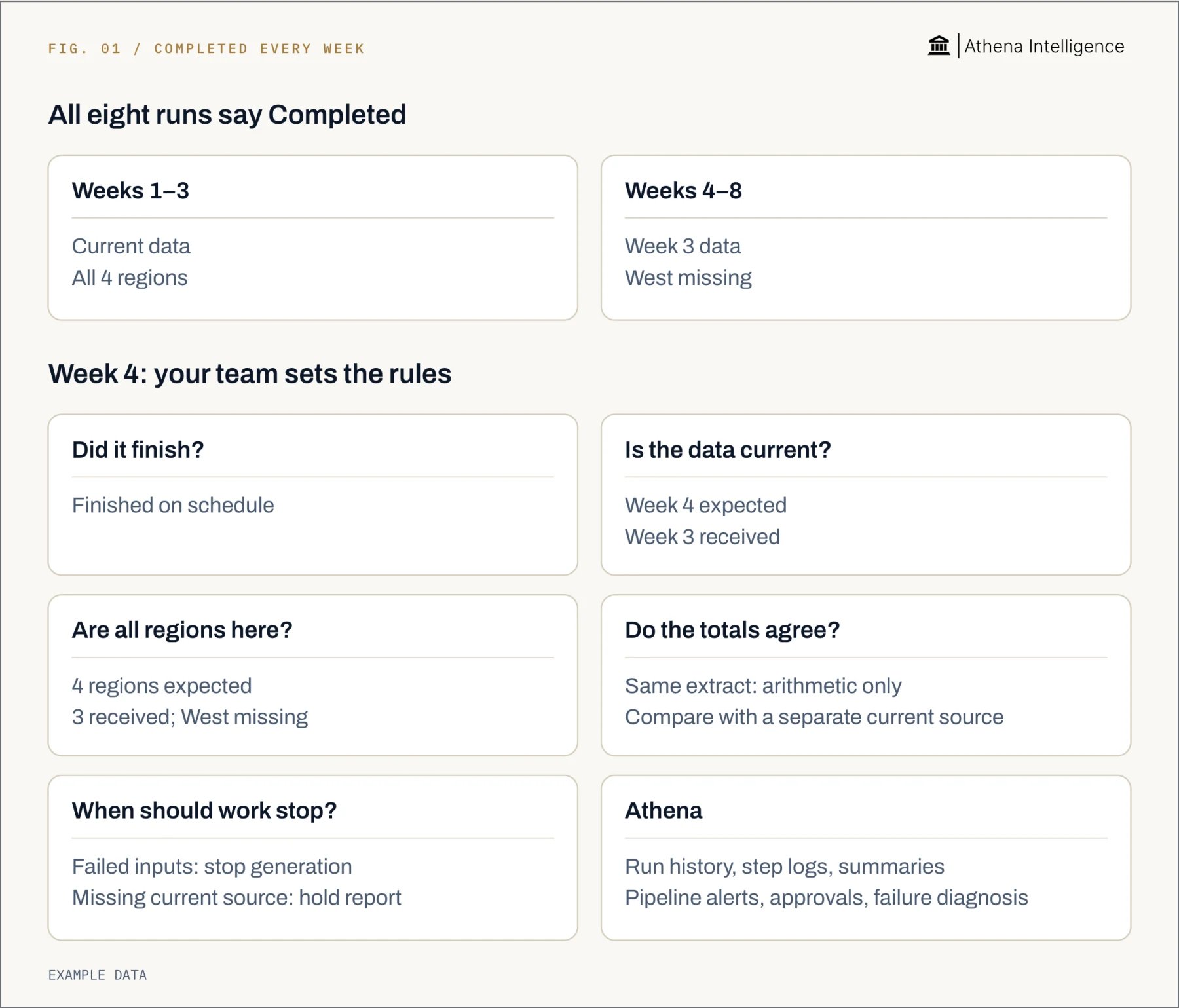
How do I check a recurring AI job before trusting its next run?
Agree on release rules with the person responsible for the result. Make each rule specific enough that another reviewer can apply it.- Write the standard of done. Name the decision, sources, period, fields, calculations, format, and reviewer. Specify returns treatment and required regions. Define what blocks release.
- Save a reviewed baseline. Preserve an accepted input and output, their dates, and the procedure used. Add cases for an empty source, missing column, stale extract, and unsupported figure. State which failures hold the report.
- Validate inputs first. Confirm access to the intended source and check age, period, columns, types, units, and coverage. Reject unapproved mappings and fallback extracts. Stop generation when a required input check fails.
- Check results before distribution. Recompute material totals outside the language model and compare them with an independently verified current source. Require references for figures and label assumptions. Hold discrepancies above the agreed tolerance.
- Review changes and sample clean runs. Repeat baseline tests after changing a source, column layout, prompt, tool, or model. OpenAI recommends evaluations on every change. Review every pilot run before deciding how much routine sampling is appropriate.
- Assign an exception owner. Send the failed check, affected period, source version, and proposed action to a named person. Set a response deadline and backup owner. Label held outputs clearly.
- Test pause and recovery. Break a test input and confirm that publication stops and the owner receives an alert. Repair the input, rerun checks, and record approval before release. Check that a retry cannot send the report twice.
How is this different from ChatGPT, Copilot, or Gemini?
OpenAI’s ChatGPT supports recurring tasks, notifications, and task management. Google’s Gemini supports recurring actions, notifications, and pause/resume controls. Microsoft’s Copilot in Excel edits workbooks and offers plan and chat modes. The useful comparison is where you define work, inspect results, and intervene. Choose the surface your reviewer can use consistently.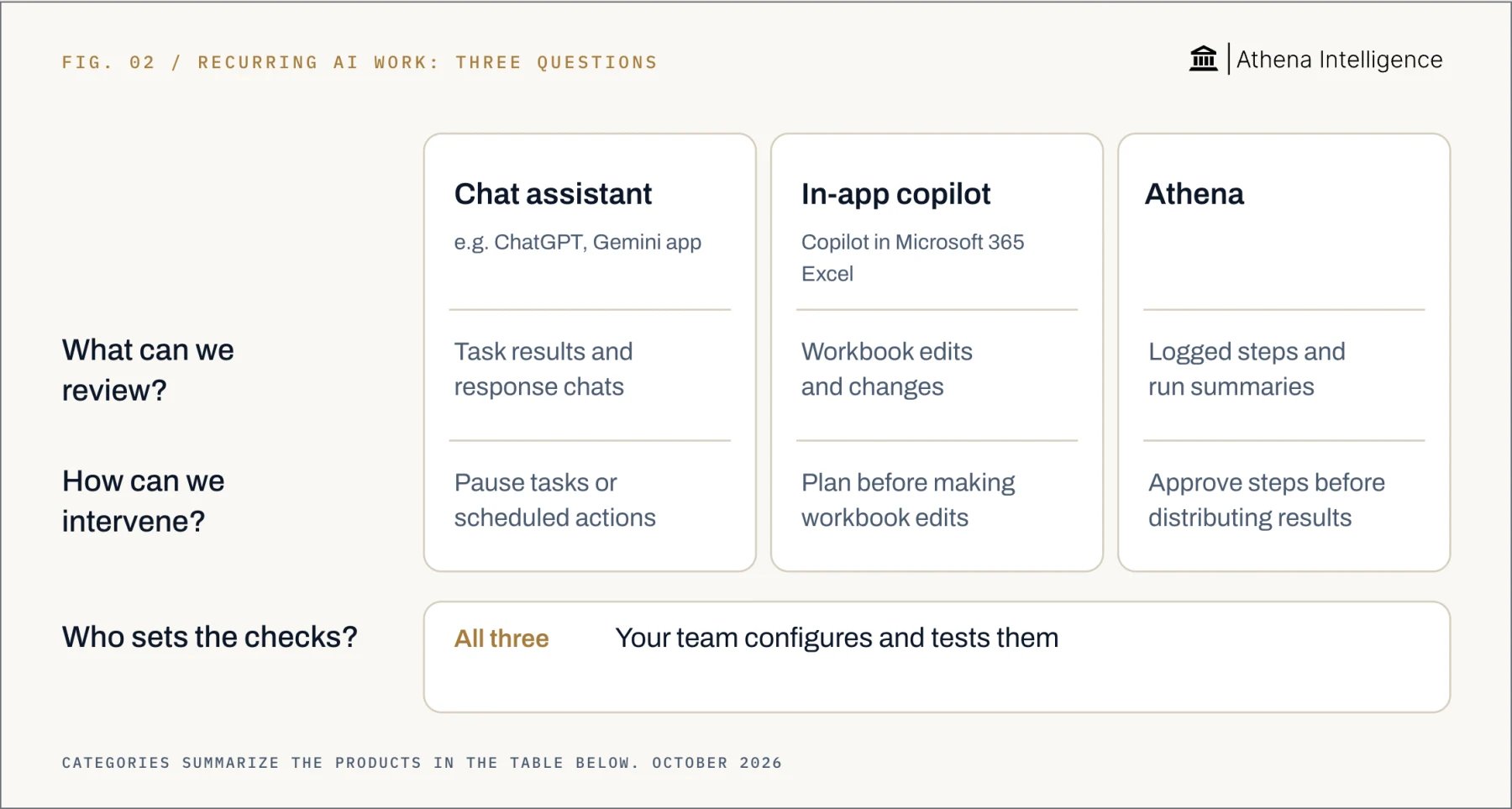
Full comparison with sources, October 2026
Full comparison with sources, October 2026
How does Athena support review of scheduled work?
In Athena Workflows, Agent Operating Procedures (AOPs) define versioned work with sources, permitted tools, output formats, and schedules. Define the procedure. Use the AOP editor to name sources and tools, specify the output, and set the schedule. Implement the input and total checks from your checklist. Set the review gate. Your workspace’s tool rules decide which tool calls pause for approval. Make sure distribution tools, such as sending email, ask before they run, so a reviewer approves or declines each send. For runs started through the API, add arun_budget with a dollar or model-call cap.
Inspect the evidence. The editor shows durations, row counts, costs, and approval states. Each run writes a summary, and every step is logged. Check the reporting period and exceptions before approving distribution.
Trace the data. Click a chart to inspect its upstream table, transformation, and freshness. Pipeline health flags stale or failed pipelines and sync gaps. Version-aware citations open the version the agent read when a source changes.
Review recovery. Athena pauses on failure, diagnoses the problem, and asks for help when needed. It can resume interrupted work, with budgets that cap retries. Approved procedure states are restorable versions of procedures.
What to plan for
Configure and test freshness, column, coverage, and total checks in every product. Monitoring can miss wrong definitions, unchecked reports, and incorrect categories hidden by a correct total. Recalculating the same stale extract checks arithmetic alone. Use an independently verified current reference for reconciliation. If it is unavailable, mark the check BLOCKED and hold the report. With a Google AI plan, Gemini prepares scheduled responses within the hour before delivery. Check upstream freshness when data changes quickly. Google’s connected-app actions also require the relevant app connection. Athena’s lineage depends on connected systems; for an emailed spreadsheet, it ends at the email. Failure recovery does not replace checks for business correctness. Test repaired or restored procedures against current inputs before release. Budget for tests and alert response. Allow for holidays and late deliveries in freshness limits. Give accepted exceptions an owner and expiry date.Questions teams ask
What is AI monitoring for scheduled business work?
What is AI monitoring for scheduled business work?
It checks execution, inputs, and outputs across repeated runs. Keep evidence and assign someone to resolve exceptions.
Is LLM monitoring enough to catch silent drift?
Is LLM monitoring enough to catch silent drift?
Include data freshness, completeness, business definitions, and independent totals in your review. Test that failed checks hold the report.
Can ChatGPT, Copilot, or Gemini help check recurring reports?
Can ChatGPT, Copilot, or Gemini help check recurring reports?
Yes: OpenAI’s ChatGPT supports recurring work through tasks. Google’s Gemini supports recurring work through scheduled actions. Microsoft’s Copilot helps edit and review workbook data. Apply your acceptance rules before distribution.
What should I do if AI made up data?
What should I do if AI made up data?
Hold the report and preserve its run and sources. Remove unsupported figures, add the failure to your tests, and review earlier affected reports.
What does Athena do differently?
What does Athena do differently?
Athena combines versioned scheduled procedures, logged steps, run summaries, approval gates, and failure diagnosis. Its data layer adds freshness tracing and pipeline health flags.
How often should a person review the job?
How often should a person review the job?
Review changed procedures and inputs before release, then set routine coverage according to consequences and demonstrated checks. NIST recommends ongoing monitoring and periodic review with defined responsibilities.