

Yes, Microsoft’s Excel with Copilot tracks supported edits with human and Copilot attribution and restores workbook versions, though “every change” has limits. Athena records saved changes with human or agent authorship, links agent edits to conversations, and supports range rollback through its Sheets and desktop Excel workflow.
What should a spreadsheet change record contain?
Start with the question a reviewer must answer: what changed, who changed it, and which saved version contains the result? Keep the instruction and source figures beside that record. A chat summary alone cannot show which numbers reached the workbook. Three records serve different needs:- Cell history helps you inspect changes to values or formulas.
- File history helps you recover an earlier workbook.
- Agent activity helps you review instructions and actions.
How do Copilot, Gemini and Athena compare?
Microsoft’s Copilot, Google’s Gemini and Athena all offer a way to inspect changed spreadsheet contents, through Excel Show Changes, Google Sheets history and Athena’s saved cell history. Their authorship, context and recovery workflows differ. The table compares those workflows for a saved edit.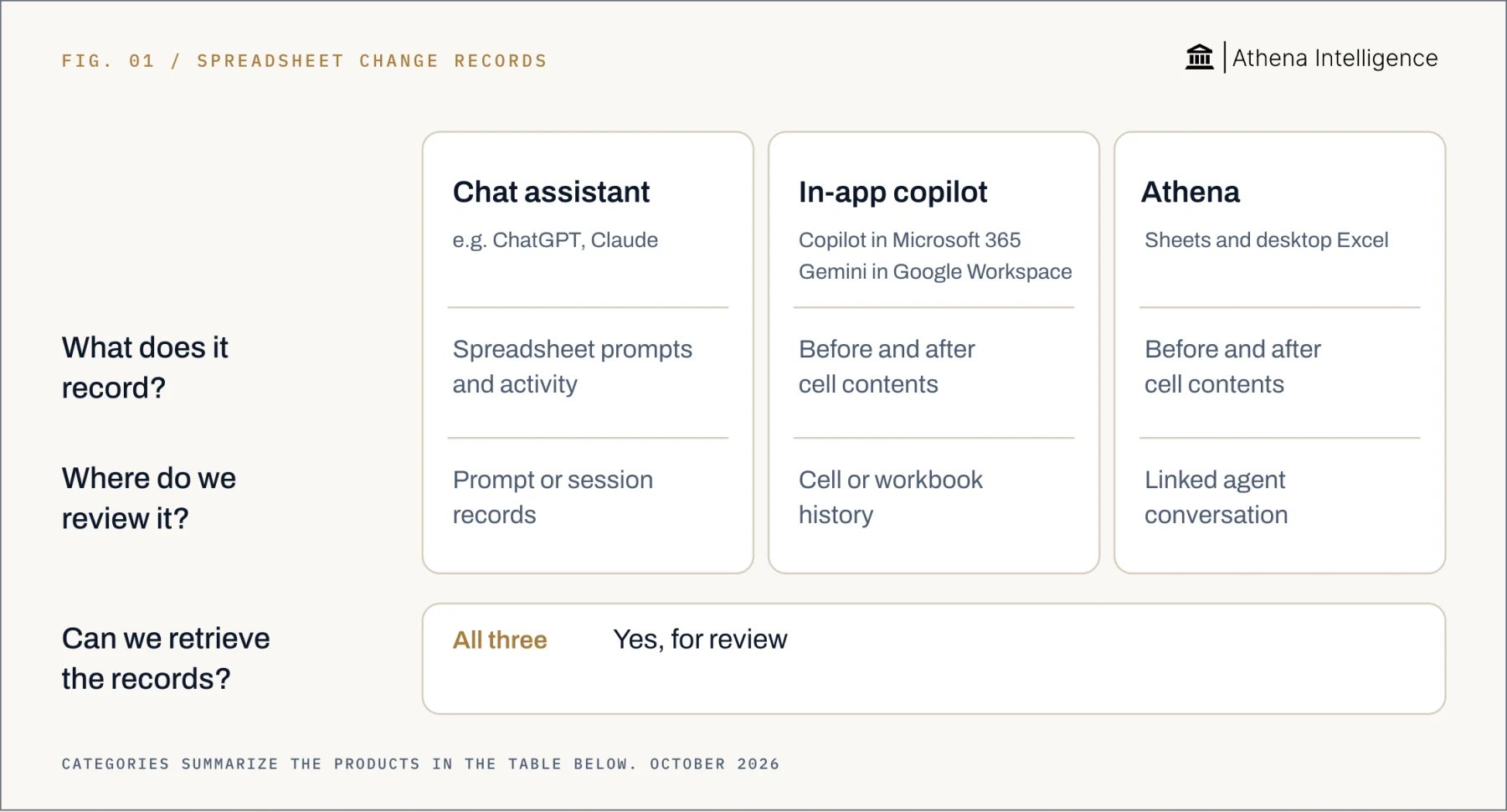
Full comparison with sources, October 2026
Full comparison with sources, October 2026
When is native version history enough?
Use native history when you need to inspect a change or recover the whole file. In Microsoft’s Excel, open Review → Show Changes to inspect supported spreadsheet edits. Open File → Info → Version History for earlier saved workbook versions. Check Microsoft’s editor name and Copilot indicator when reviewing an AI edit. Then compare the affected cells with the instruction and source figures. Keep the version you approved with the supporting evidence. In Google Sheets, right-click a cell and choose Show edit history. Open Last edit / Version history to inspect earlier file versions. Google’s Workspace conversation history gives you another place to review your Gemini chats. Whole-file recovery suits a workbook whose later changes can all be discarded. A forecast with several approved corrections needs a more selective recovery test. Decide which cells must return to their old state and which must remain untouched.How does Athena handle review and range rollback?
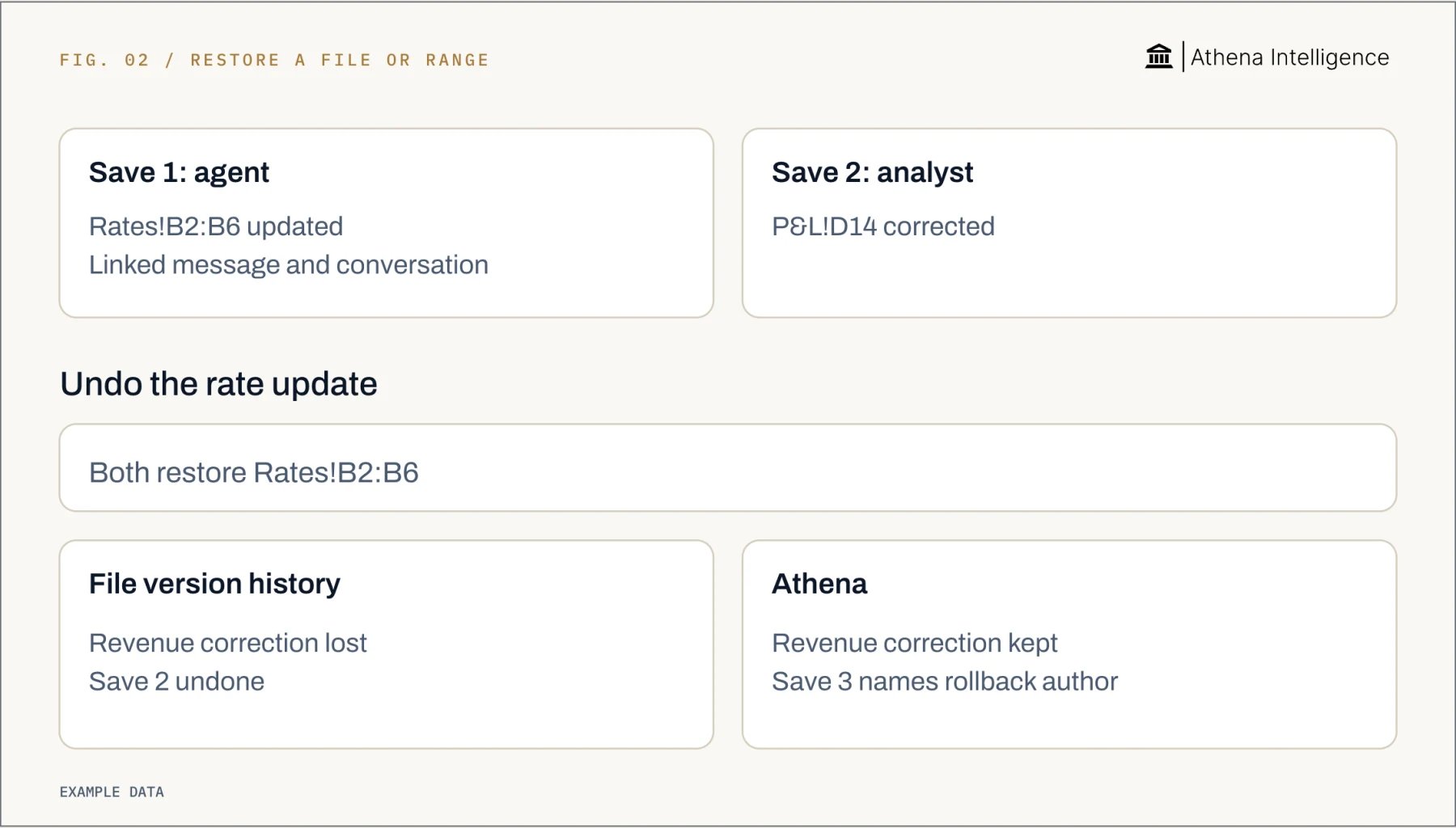
Athena Sheets records the author and before/after contents at each save. Agent edits link to the session and message behind the work. Use that connection to move from a changed number to the instruction that caused it. For desktop Excel, choose Copy to Athena in the Office add-in. This moves the workbook into Studios, Athena’s editing workspace, and sync returns the result with attribution. The add-in keeps the history intact through sync with Athena Sheets. Review a fictional exchange-rate edit in four steps:- Open Activity Monitor. Find the affected range and inspect the old and new contents.
- Open the linked conversation. Read the message that triggered the edit and the explanation in the conversation, then compare the rate with your retained source.
- Open Compare in Editor. Inspect the saved states side by side.
- Roll back the range. Keep changes outside the selected range and inspect the recorded rollback author.
How should you test recovery before using real figures?
Run the same exercise for each candidate tool on a workbook with fictional figures. This is a proposed test, not a result. Make the expected outcome clear before the assistant edits anything.- Save a baseline. Note the exchange-rate range and a separate revenue cell.
- Ask the assistant to change only the exchange rates. Save and retain the instruction and source rates.
- Have an analyst correct the separate revenue cell. Save again.
- Find the saved exchange-rate edit. Retrieve its author, previous contents, new contents and instruction.
- Recover only the exchange-rate range. Check that the later revenue correction remains and dependent formulas calculate correctly.
- Export the evidence. Ask another authorized reviewer to retrieve the same edit and reviewed version.
What to plan for
History has boundaries. Microsoft’s Excel Show Changes excludes formatting and some object changes; code or add-ins can leave prior values missing. Google’s cell history omits some row, column, formatting and formula-result changes. Restoring a Google spreadsheet clears cell history from before the restore, so preserve a copy when you need that record. Google’s Gemini last-action Undo must happen before further edits. Athena keeps history per save; same-cell edits within one save retain the last writer and before/after contents. Set up access before testing. Microsoft’s Excel version history needs OneDrive or SharePoint, and the Copilot workflow needs a commercial Microsoft 365 Copilot subscription. Google’s Gemini features use native Sheets files, while Workspace conversation history needs administrator-enabled Gemini Beta access. Anthropic’s Claude custom collection service requires access through an Enterprise subscription. Its default cap is 4,000 characters per prompt or tool input/output field, and assistant response text is excluded. Claude sessions in the Enterprise Compliance API are separate from Enterprise audit logs; the API is in public beta. DataSnipper users can turn off activity recording. xltrail excludes calculated results from its tracked cell differences. Account for these limits when deciding which evidence to retain. Agree on retention periods, reviewer permissions and export fields. Ask vendors how deletion affects conversations, change logs and backups. Check source figures and calculations independently before approval. Workbook rollback cannot retrieve disclosed information. Sent email and committed business-system writes remain outside Athena’s workbook rollback. A change record does not prove correctness or accounting compliance.Questions teams ask
Is there an AI tool for Excel that tracks every change and lets you roll back?
Is there an AI tool for Excel that tracks every change and lets you roll back?
Microsoft’s Copilot tracks supported edits with attribution for Copilot edits and offers recovery of workbook versions. Athena records saved spreadsheet changes and supports rollback of selected ranges with history retained through Excel sync.
Which AI tools keep records of spreadsheet changes?
Which AI tools keep records of spreadsheet changes?
Microsoft’s Copilot, Google’s Gemini and Athena offer spreadsheet change history through Excel Show Changes, Google Sheets history and Athena’s saved cell history. DataSnipper records spreadsheet agent actions, while OpenAI’s ChatGPT offers enterprise records of spreadsheet prompts and responses and Anthropic’s Claude offers enterprise records of prompts or tool activity.
What makes an AI spreadsheet workflow suitable for accounting?
What makes an AI spreadsheet workflow suitable for accounting?
Require source figures, named authors, saved before/after contents, independent calculation checks and demonstrated recovery. Set approval responsibilities before using real financial data.
Can Athena restore a range without removing later corrections elsewhere?
Can Athena restore a range without removing later corrections elsewhere?
Athena supports selected-range rollback while keeping other changes. Use the fictional workbook exercise above to check your team’s recovery flow.
What is an AI audit trail?
What is an AI audit trail?
It records an AI system’s inputs, actions or changes and the context needed to review them. For spreadsheets, distinguish chat records from saved cell history.
What should an AI agent record let a reviewer do?
What should an AI agent record let a reviewer do?
Find the changed range, its author, the instruction and the saved version. Then recover the intended cells and check the resulting calculations.