Microsoft defines shadow AI as workplace AI use without IT visibility or approval. Reduce it with approved tools for useful tasks, clear data rules, and tested access, approval and recordkeeping controls.
What is shadow AI, and what actually goes wrong?
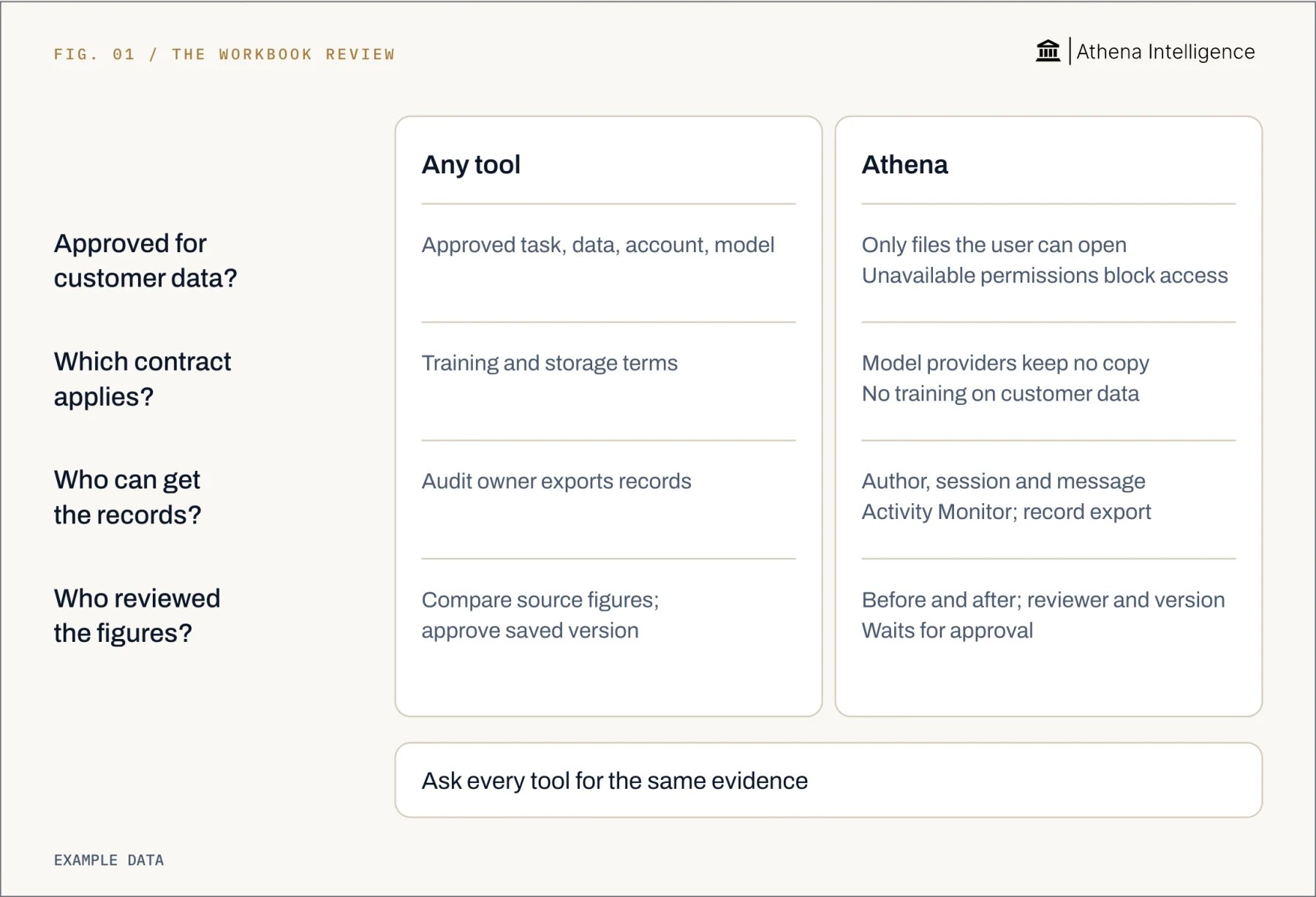
Microsoft warns that unmanaged AI use can expose data, create security vulnerabilities, violate compliance requirements and leave work without an audit trail. Start by asking employees which tasks need AI and where approved tools failed them. Record the tool, account, data and actions involved. Help people move the task into an approved environment. Consider an analyst uploading a customer margin workbook to a personal assistant account. The team needs answers to four questions:- Was the account approved for customer data?
- Which contract governs the upload?
- Who can retrieve the interaction record?
- Who checked the resulting figures?
Which AI governance framework should we use?
NIST’s AI Risk Management Framework is voluntary, with four iterative functions. Govern applies across Map, Measure and Manage.- Govern: Assign owners, approval authority and policy responsibilities.
- Map: Describe the task, data, affected people and possible failures.
- Measure: Test access boundaries, output quality and review coverage.
- Manage: Approve, restrict, improve or retire the use.
What should an AI acceptable use policy say?
Publish approved tools beside the policy. Include work accounts, permitted data classes, supported tasks and a help contact.- Discover current use. Compare employee reports with procurement, expenses, application inventories and access records. Include embedded AI and local agents.
- Define allowed data. Specify permitted data classes and approval requirements for sensitive information. Use synthetic data for unapproved trials.
- Separate drafting from acting. Name reviewers for material outputs. Require approval before consequential sends, publications or system changes.
- Review accounts and contracts. Check training use, retention, deletion, processing providers and connected access. Record the approved configuration and review date.
- Set limits and records. Define access scope, spending limits and evidence retention. Name who can inspect logs and revoke access.
- Provide exceptions and training. Give requests an owner and response target. Teach the approved workflow and how to report accidental uploads.
Use approved work accounts for approved tasks and data classes. Obtain approval before uploading restricted information or connecting production write access. Review material outputs before use.Have business, security and legal owners approve the policy. Pair each rule with a configuration check or review record.
How do we audit AI use and test the controls?
Define the tools, teams, workflows, period and criteria in scope. NIST calls for testing before deployment and during operation, with independent review where appropriate.- Reconcile the inventory. Compare registered uses with discovery records. Investigate ownerless tools, personal accounts holding work data and unexplained agent access.
- Select workflows by risk. Sample sensitive data, external actions and material outputs.
- Test denied access. Use synthetic files with different permissions. Check that unauthorized users and agents cannot retrieve or modify restricted files. Repeat after revocation.
- Test approvals and budgets. Attempt an action requiring review and check that it waits for the authorized reviewer. Inspect what happens at a spending cap.
- Trace a completed task. Follow its instruction, inputs, output, changes and approval. Recheck material results and identify the version reviewed.
- Record and retest findings. Assign each failed control an owner and correction date. Preserve the retest result and escalate unresolved risks.
How does this compare with ChatGPT, Copilot or Gemini?
Compare the same margin-workbook task in approved work accounts. OpenAI’s ChatGPT Enterprise provides audit records. Microsoft’s Copilot in Microsoft 365 provides audit records. Google’s Gemini in Workspace also provides audit records. Athena also provides audit records.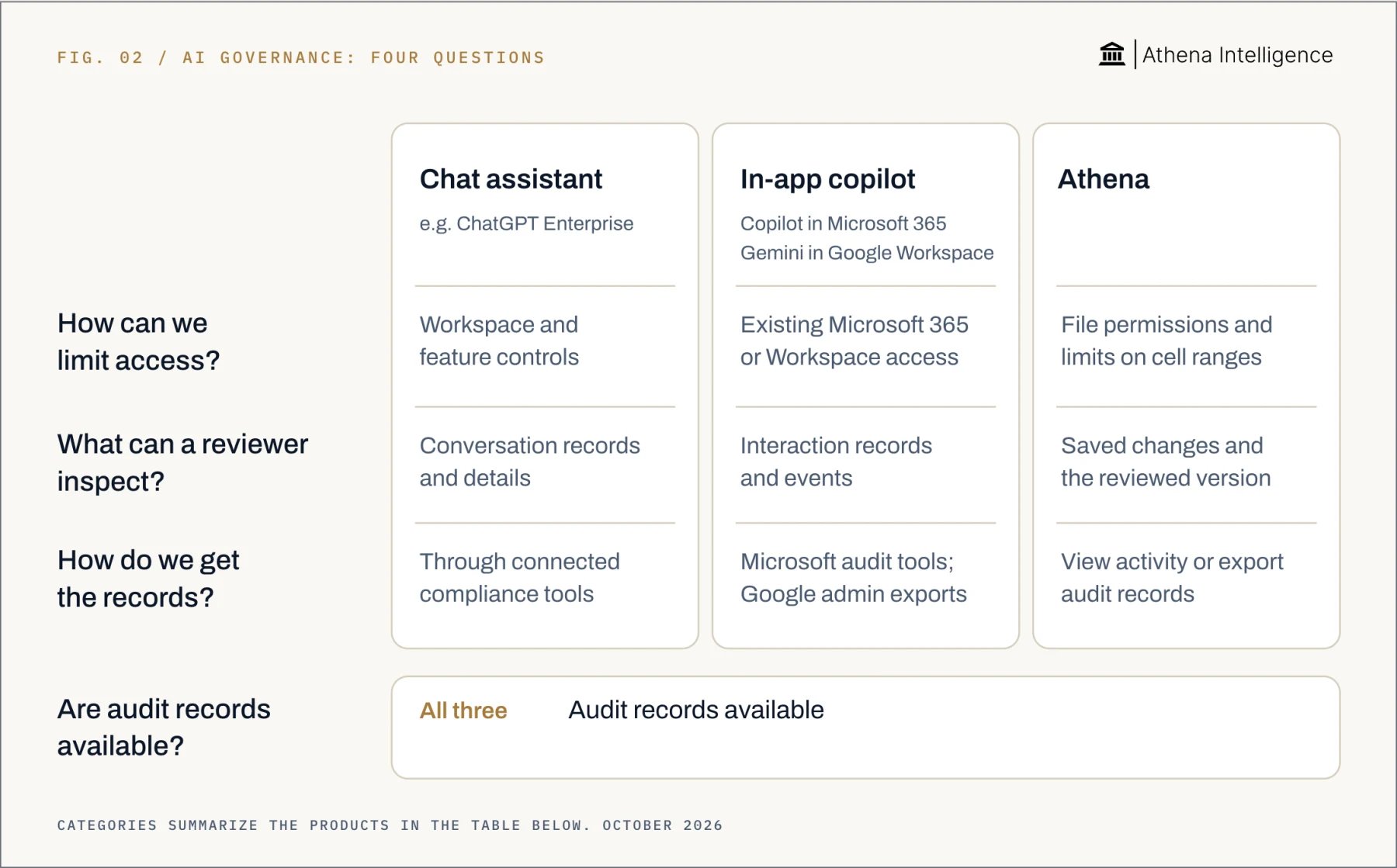
Full comparison with sources, October 2026
Full comparison with sources, October 2026
How does Athena put the policy into practice?
Use a bounded pilot to connect policy rules to a working task:- Set identity and scope. Athena agents inherit live source permissions, with asset and cell-range restrictions. Test allowed and denied tasks using synthetic workbooks.
- Choose the model. Select a specific model and configure a backup provider for outages. Athena’s provider agreements include zero data retention and no customer-data training.
- Cap the run. Create an Athena Agent Operating Procedure, a versioned workflow. Set a dollar limit with
max_cost_usd, a model-call limit withmax_model_calls, or both in the run’srun_budgetwhen you start it through the API. - Inspect saved changes. Use Activity Monitor and Compare in Editor. Athena saves identify the human or agent author, session and message, with audit-log export available.
- Require tool approvals. Set your workspace’s tool rules so consequential tools ask for approval before they run. Record who reviews them and retest after procedure changes.
What to plan for
Discovery can miss personal accounts and unmanaged devices. Record coverage gaps and sampling limits, and assign an owner to improve visibility. The NCSC advises you to avoid sensitive information in public AI queries. Assess the exact business account’s agreement before approving sensitive work. Athena inherits excessive source sharing and does not repair it. Correct over-shared folders before approving sensitive workflows. Ask vendors how long they retain conversations, work products, audit records and backups. Review platform storage separately from model-provider retention agreements. Check output accuracy against source data. Sent email and committed enterprise resource planning rows are examples of Athena actions that cannot be undone. Require review before those actions and keep an incident response plan. Read the full ISO standard before making a conformity claim. Assign owners to interpret legal obligations, test controls and accept remaining risk.Questions teams ask
What counts as shadow AI?
What counts as shadow AI?
Microsoft defines shadow AI as workplace AI use without IT visibility or approval. Inventory the task, account and data so remediation addresses the actual use.
Should we ban AI to stop shadow AI?
Should we ban AI to stop shadow AI?
Provide an approved route and restrict specific unsafe uses. Offer a quick exception process and check whether approved tools support employees’ work.
What is the difference between NIST AI RMF and ISO 42001?
What is the difference between NIST AI RMF and ISO 42001?
NIST’s AI RMF is voluntary risk-management guidance organized around four functions. ISO’s ISO/IEC 42001 sets requirements for an organizational AI management system.
What should an AI audit produce?
What should an AI audit produce?
Produce a scoped inventory, control tests, sampled evidence, findings with owners and retest results.
Can ChatGPT, Copilot or Gemini support AI governance?
Can ChatGPT, Copilot or Gemini support AI governance?
Yes. OpenAI’s ChatGPT Enterprise provides workspace and feature controls and audit records through its Compliance Platform. Microsoft’s Copilot provides administrative controls and audit records. Google’s Gemini in Workspace provides controls through Workspace permissions and Gemini interaction audit records. Test the configuration and evidence your authorized reviewers can retrieve.
What does Athena do differently for shadow AI governance?
What does Athena do differently for shadow AI governance?
Athena connects saved changes to their author and reviewed version, alongside source permission controls and configurable run budgets. Use those controls to review the work itself.