

It can be safe when your company approves the tool, account, data and settings for a defined workflow. Check training and retention, access to company data and processing location before uploading confidential material. OpenAI, Microsoft and Google describe these controls for their business products.
Will the AI vendor train on our company data?
Start with the account, not the brand. OpenAI says individual ChatGPT content may be used for training unless you opt out. ChatGPT Business, Enterprise and API data are excluded by default. Anthropic excludes commercial Claude inputs and outputs from training by default. Consumer Claude uses separate rules for model-improvement consent and safety review. Microsoft says Copilot does not use prompts, responses or Microsoft Graph data to train foundation models. Google protects Gemini in Workspace from training without permission. That protection also covers the Gemini app on qualifying Workspace accounts. Athena does not train on customer data across its deployment options. A no-training policy answers one privacy question. It does not replace decisions about storage, access or sharing. Keep the agreement and settings for the approved account with the workflow record. Staff should know which account to use before they open a confidential file.How long is data kept, and who can see it?
Review uploads, conversations, model requests and logs as separate records. They can have different retention settings. OpenAI says ChatGPT Business and Enterprise offer administrator retention controls. Anthropic says Claude for Work keeps saved conversations, while Claude Enterprise offers custom retention controls. For OpenAI API requests, default abuse-monitoring logs can persist for up to 30 days. Some saved application objects remain until deleted. Anthropic normally deletes API inputs and outputs within 30 days. Microsoft stores Copilot interactions and offers Purview retention controls. Google gives administrators separate retention settings for Gemini in Workspace and the Gemini app. Access also depends on the record. OpenAI permits administrator access and limited employee access to Enterprise conversations. Google says Workspace side-panel conversations are visible only to the user, even inside shared files. Ask who can access each record: coworkers, administrators, compliance staff, vendor personnel or suppliers. Review the audience for a generated document separately from the audience for its chat.Can an assistant expose files without breaking permissions?
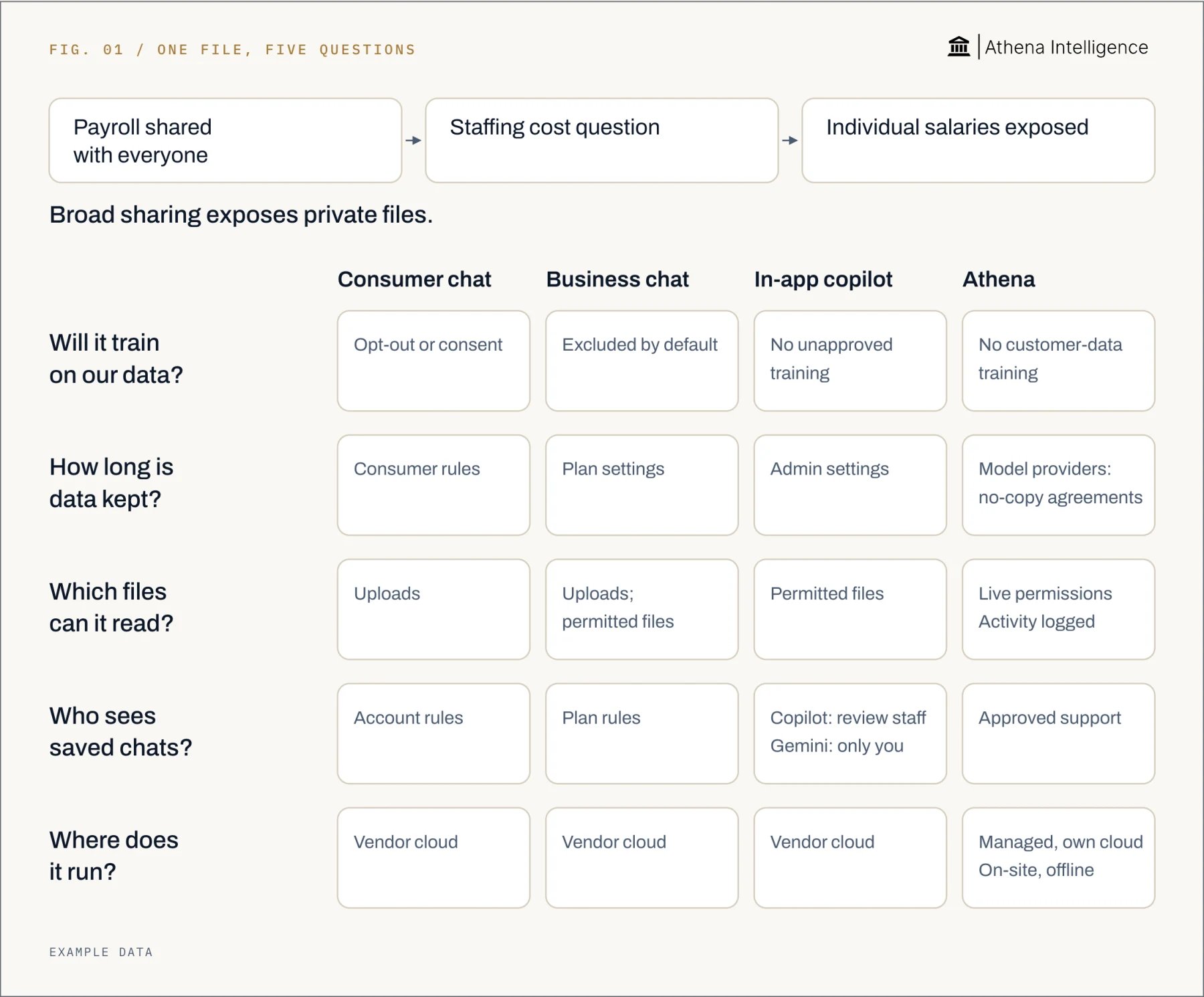
Yes. Microsoft says Copilot can surface organizational data that a user has permission to view. Microsoft warns that overshared content can increase risk. Consider a synthetic example. A payroll workbook sits in a SharePoint folder shared with all employees. An operations analyst asks for staffing costs, and the assistant finds it. The analyst has access, even though the task does not require individual salaries. Repairing the folder’s sharing settings addresses the underlying problem. Before connecting files, review:- Broad groups and inherited access.
- Anonymous and organization-wide links.
- Former staff and guest accounts.
- Sensitive records mixed into general folders.
What should I check before uploading company data?
Approve one workflow at a time. Keep these checks with its approval record so another owner can understand the decision.- Classify the material. Identify confidential data, personal records, contract restrictions and secrets. Start with a redacted sample and name the person who can approve its use.
- Verify the account. Record the product, workspace and agreement. Check OpenAI’s individual-account training settings and business-account data-sharing settings. Check Anthropic’s commercial-account training settings and consumer-account model-improvement consent for the company account.
- Map the route. List the source system, assistant, model provider, connected tools and output destination. Include fallback models and external search.
- Record retention. Write down periods for uploads, conversations, requests and logs. Include OpenAI’s deletion rules, Anthropic’s deletion rules and Microsoft’s compliance holds.
- Test access. Create synthetic permitted and denied documents. Ask the assistant to find both, remove a permission, then repeat the test.
- Limit actions. Start with selected sources and reading access. Following OWASP’s advice, require review before sending information or changing business records.
- Prepare to stop. Name who can disconnect sources, revoke credentials and investigate unexpected results. Recheck approval when the model, connector, data or audience changes.
How do enterprise AI tools compare?
This comparison uses ChatGPT Business, Microsoft 365 Copilot and Gemini in Google Workspace. Google’s Workspace privacy protections cover Gemini on Workspace Business Standard accounts. Each offers training protections, while hosting and retention controls differ.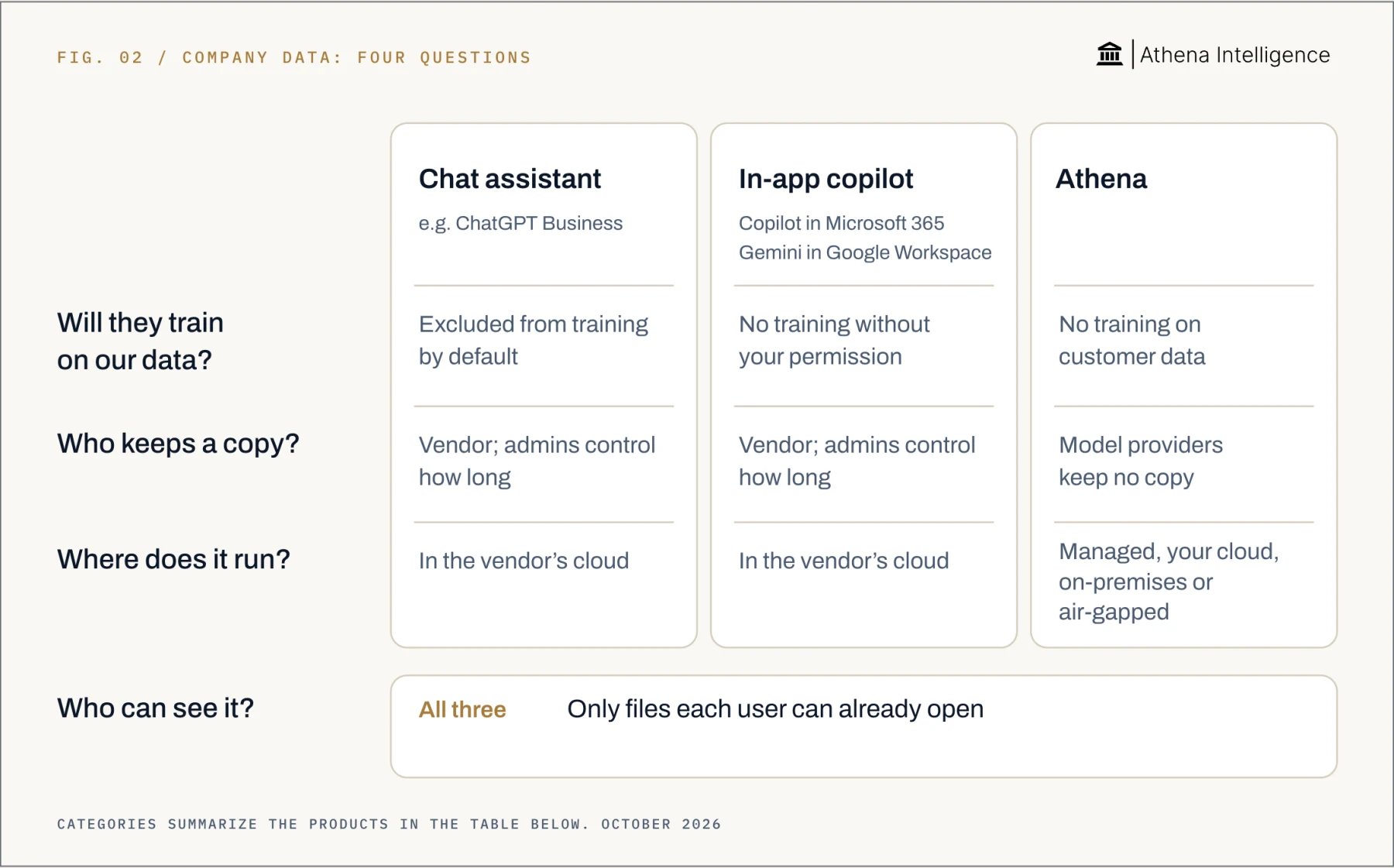
Full comparison with sources, October 2026
Full comparison with sources, October 2026
How does Athena handle deployment, models and identity?
Athena offers managed cloud, your own cloud account, on-premises deployment and offline operation. Choose the boundary before connecting sensitive sources. You can select providers, keep a fixed model or let Athena select a model for each task. Open-source models can run inside your private cloud network or an environment disconnected from external networks. Users sign in through your company identity system, and agents have their own directory identities. Administrative integrations use credentials separate from user-linked accounts. Athena checks source permissions per user in real time. It also supports asset view, edit and share controls, including spreadsheet-range restrictions. Access is denied when the permission service cannot be reached. Every read and action is logged. Support access requires customer approval for each incident and is time-bounded and logged. For a pilot, name the user group, agent owner, source folders and output audience. Match the recorded identity to the person or agent performing the work.What to plan for
Training exceptions. OpenAI says ChatGPT feedback can include its conversation, and business products allow explicit data-sharing exceptions. Anthropic says Claude commercial feedback or consent can permit training; Team and Enterprise owners can disable chat ratings. Retention exceptions. OpenAI’s deletion rules and Anthropic’s deletion rules can have legal and safety exceptions. Microsoft compliance holds can preserve interactions after visible history is deleted. Google says Gemini app history can persist up to 72 hours when history is off. Zero retention coverage. OpenAI’s zero-retention options have eligibility and feature limits. Anthropic requires 30-day retention on affected Covered Model routes, with eligible-customer exceptions and controlled human review. Check the selected model, features and fallbacks against Athena’s provider agreements. Location. Own-cloud hosting does not settle where an external model processes data. Specify a local model when external calls are prohibited. OpenAI distinguishes API storage from processing regions; Microsoft has regional rules and an EU Data Boundary exception for Anthropic models. Inherited access. Athena’s live permissions preserve existing access, including overshared folders. Maintain source permissions and check the recipients of generated reports. Obtain Athena’s retention and deletion periods for conversations, logs, caches and backups in your deployment. Assign an owner to review these settings when the workflow changes.Questions teams ask
Can I put confidential information in ChatGPT?
Can I put confidential information in ChatGPT?
Use a company-approved workflow and account. OpenAI says ChatGPT Business and Enterprise exclude business data from training by default.
Does ChatGPT train on my data?
Does ChatGPT train on my data?
OpenAI says individual ChatGPT content may be used for training unless you opt out. Business, Enterprise and API data are excluded by default.
Does Claude train on my data?
Does Claude train on my data?
Anthropic says commercial Claude inputs and outputs are excluded from training by default. Consumer Claude has separate consent and safety-review rules.
Does zero data retention mean nothing is saved anywhere?
Does zero data retention mean nothing is saved anywhere?
Zero retention covers the data and features included in the agreement. OpenAI’s saved application records and Anthropic’s saved conversations can have separate rules.
Can an assistant find confidential files I can already access?
Can an assistant find confidential files I can already access?
OpenAI’s ChatGPT apps respect existing source permissions, as does Microsoft’s Copilot service. Following Microsoft’s guidance, review broad sharing before enabling retrieval.
How does Athena keep company data private?
How does Athena keep company data private?
Athena combines its deployment choices and its model choices with live source permissions, directory identities and access logs. Choose those controls for the workflow you are approving.