

run_budget limits the model calls or model cost of one execution. Set it when starting an Agent Operating Procedure (AOP) through the asynchronous or batch API to stop a run before it admits further model calls beyond its budget.
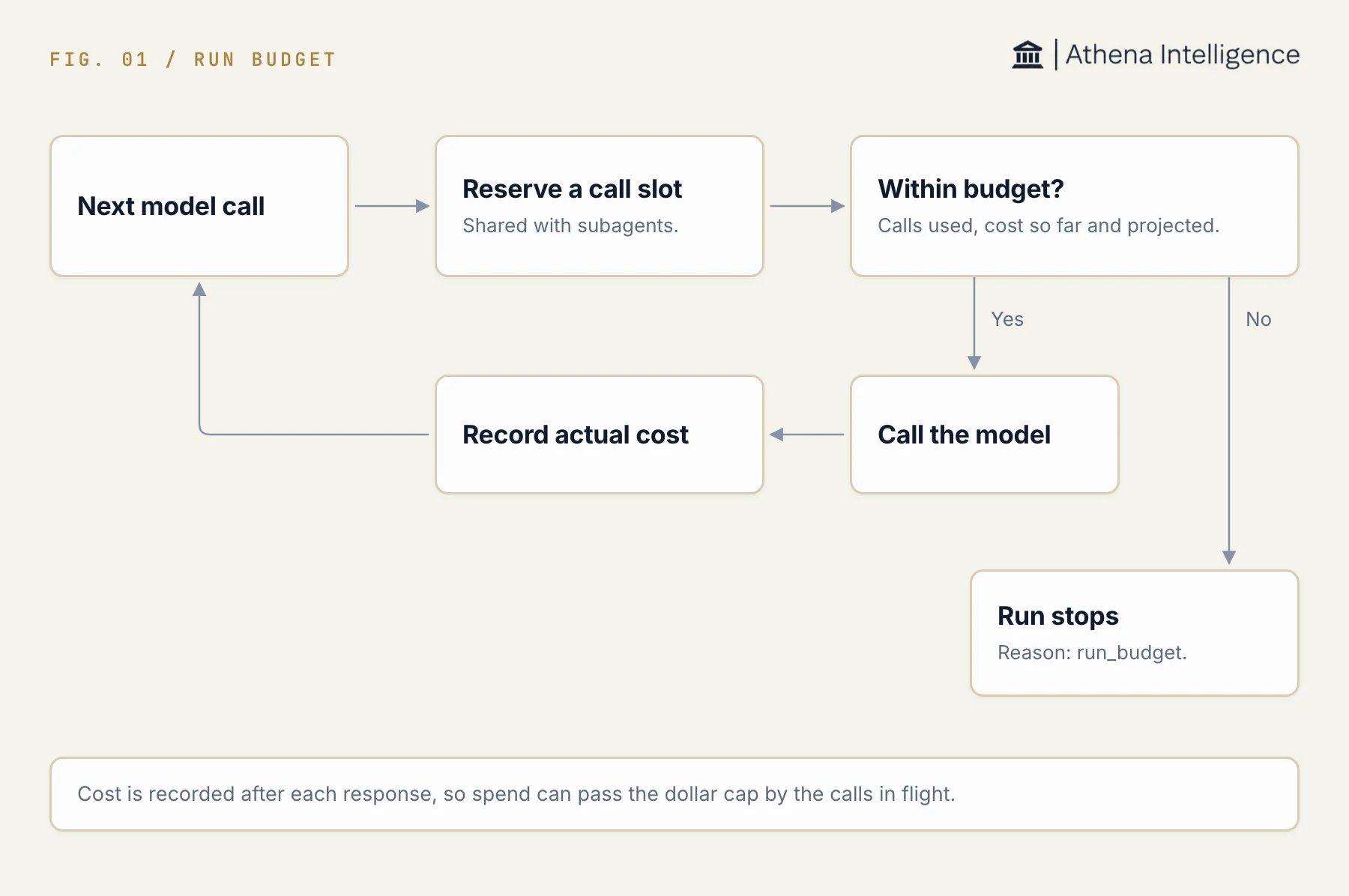
Each model call reserves a slot and passes a budget check before it runs.
Choose limits
Set either field or both. An empty budget is invalid, and additional fields are refused.
When you set both limits, either can stop the run. Reaching one does not leave the other available as extra capacity.
If the agent definition also supplies a budget, Athena combines the budgets using the lower value for each limit. A request cannot raise a definition’s cap.
Start a budgeted execution
The public API supports these execution paths:
The API schema names these operations
aop.execute_async and aop.execute_batch. Use the matching SDK method if its request type has a run_budget field. Otherwise send the HTTP request directly.
- Choose an AOP you can run.
- Add
run_budgetbesideasset_idanduser_inputsin the request body. - Send the request to
POST /api/v0/aop/execute-asyncwith your API authentication. - Use the returned
thread_idto track execution.
run_budget at the top level beside runs. Each execution gets its own budget. The amount is not one shared spending pool for the whole batch.
Understand call admission
The main run and all its subagents share one execution ledger. A subagent does not receive a fresh copy of the budget. Before each model call, Athena reserves a call slot. Concurrent subagents compete for the same slots, so they cannot each take the last permitted call. Failed provider attempts still consume their reserved slots, including retry and fallback attempts. For a dollar limit, Athena checks accumulated cost before admitting a call. It also estimates the next call using the previous completed call’s cost and refuses a call projected to cross the limit. Cost is recorded after the response reports usage. Actual spend can exceed the dollar limit by the cost of calls already in flight, and their actual cost can differ from the estimate. Treatmax_cost_usd as an admission limit rather than an exact final invoice ceiling.
Handle a stopped run
When a budget check refuses the next model call, Athena stops the run with a budget-exhausted failure. It recordsathena_termination_reason=run_budget, and the AOP execution does not report success.
Review the work completed so far and the failure message before starting another execution. A new execution can use a larger budget if you choose to continue.
A dollar-budgeted run also stops at its next admission if a completed model call cannot be priced. Use a call-count budget when dollar metering is unavailable for the model.