> ## Documentation Index
> Fetch the complete documentation index at: https://resources.athenaintel.com/llms.txt
> Use this file to discover all available pages before exploring further.
# How do we keep AI agent costs under control and prove ROI?
> Understand AI seat and token pricing, stop runaway agent loops, set budgets, and measure cost per accepted outcome. See Athena's governance controls.
> Control AI agent costs with separate license and usage budgets, enforced execution limits, and total cost per accepted outcome. Athena adds [per-run dollar and model-call limits](https://athenaintel.com/product/trust/budgets-governance/), shared across sub-agents.
## What are we paying for: seats, tokens, or agent actions?
Seats buy access. Tokens price model input and output. Credits price agent activity.
Forecast each separately, then combine them in the workflow budget.
These US list prices provide a starting point:
* **ChatGPT Business:** OpenAI lists \[$20 per seat monthly with annual billing](https://openai.com/business/pricing/), or $25 with monthly billing. Enterprise uses custom pricing.
* **Microsoft 365 Copilot:** Microsoft lists [\$30 per user monthly, paid yearly](https://www.microsoft.com/en-us/copilot/pricing/enterprise), plus a qualifying Microsoft 365 license.
* **Google Workspace Business Standard:** Google lists [\$14 per user monthly with a one-year commitment](https://workspace.google.com/pricing.html), before promotions. It includes [Gemini in Workspace apps](https://support.google.com/gemini/answer/14620100?hl=en).
* **Copilot Studio:** Microsoft lists [\$200 monthly for 25,000 tenant-wide Copilot Credits](https://www.microsoft.com/en-us/copilot/pricing/copilot-studio); pay-as-you-go is also available.
OpenAI bills [ChatGPT subscriptions and API usage separately](https://help.openai.com/en/articles/9039756-billing-settings-in-chatgpt-vs-platform). Google also has [separate, model-specific Gemini API usage pricing](https://ai.google.dev/gemini-api/docs/pricing).
For each model call, multiply uncached input, cached input, and output tokens by [OpenAI’s respective token rates](https://developers.openai.com/api/docs/models/gpt-5.4-mini). Divide the sum by one million.
OpenAI’s GPT-5.4 Mini charges $0.75 per million input tokens, $0.075 for cached input, and $4.50 for output. A synthetic call with 20,000 uncached input tokens and 2,000 output tokens costs $0.024 at these rates.
One thousand identical calls cost $24. One thousand tasks with ten calls each cost $240. That difference makes call counts essential to forecasting.
## What makes an agent loop expensive?
Imagine an agent retrying a failed lookup, rereading a file, then asking another agent to investigate. The second agent repeats the lookup. Neither produces an accepted result, but billable attempts continue.
OWASP treats uncontrolled model usage as [an unbounded-consumption risk](https://genai.owasp.org/llmrisk/llm102025-unbounded-consumption/). It recommends quotas, timeouts, monitoring, and limits on inputs and actions.
Give each task an allowance below the monthly cap. Parallel workers should draw from one shared budget. Test concurrent calls before running a large batch.
Record retries against the original task. Otherwise, splitting failed work into new runs can hide its total cost.
## How do we set an AI budget that stops spending?
1. **Name the work and owner.** Define one accepted output, expected monthly volume, and the person who approves spending.
2. **Set several limits.** Cap dollars per task and batch. Also limit calls, retries, elapsed time, and concurrent workers.
3. **Test the stop.** Run a deliberately failing task with a small allowance. Check whether execution stops, pauses for approval, or only sends an alert.
4. **Test shared work.** Repeat with parallel workers and unavailable billing information. Check the total charged to the task.
5. **Bound recovery.** Stop attempts that repeat an error without new evidence. Require the owner to approve further work.
6. **Reconcile weekly.** Record owner, model, usage cost, retries, review time, and acceptance. Match totals to invoices and investigate expensive failures.
OpenAI's Agents SDK [stops when execution exceeds its `max_turns` limit](https://openai.github.io/openai-agents-python/running_agents/). Use it to bound iterations, alongside a separate dollar allowance.
Choose one recurring workflow for the first trial. Use the same inputs and acceptance criteria when comparing cheaper models.
## How do we prove AI ROI without inflating savings?
Measure the manual and AI-assisted workflow against identical acceptance criteria. Include routine items, difficult items, and failures. The workflow owner should review quality.
Track staff time separately from elapsed time. A faster result can still require substantial review.
Use three measures:
* **Cost per accepted outcome:** Total workflow cost divided by accepted outputs. Include failed runs in the cost.
* **Net benefit:** Manual baseline cost plus separately evidenced additional benefit, minus total AI workflow cost.
* **ROI:** Net benefit divided by total AI workflow cost, multiplied by 100. State the period and whether benefits represent capacity or cash.
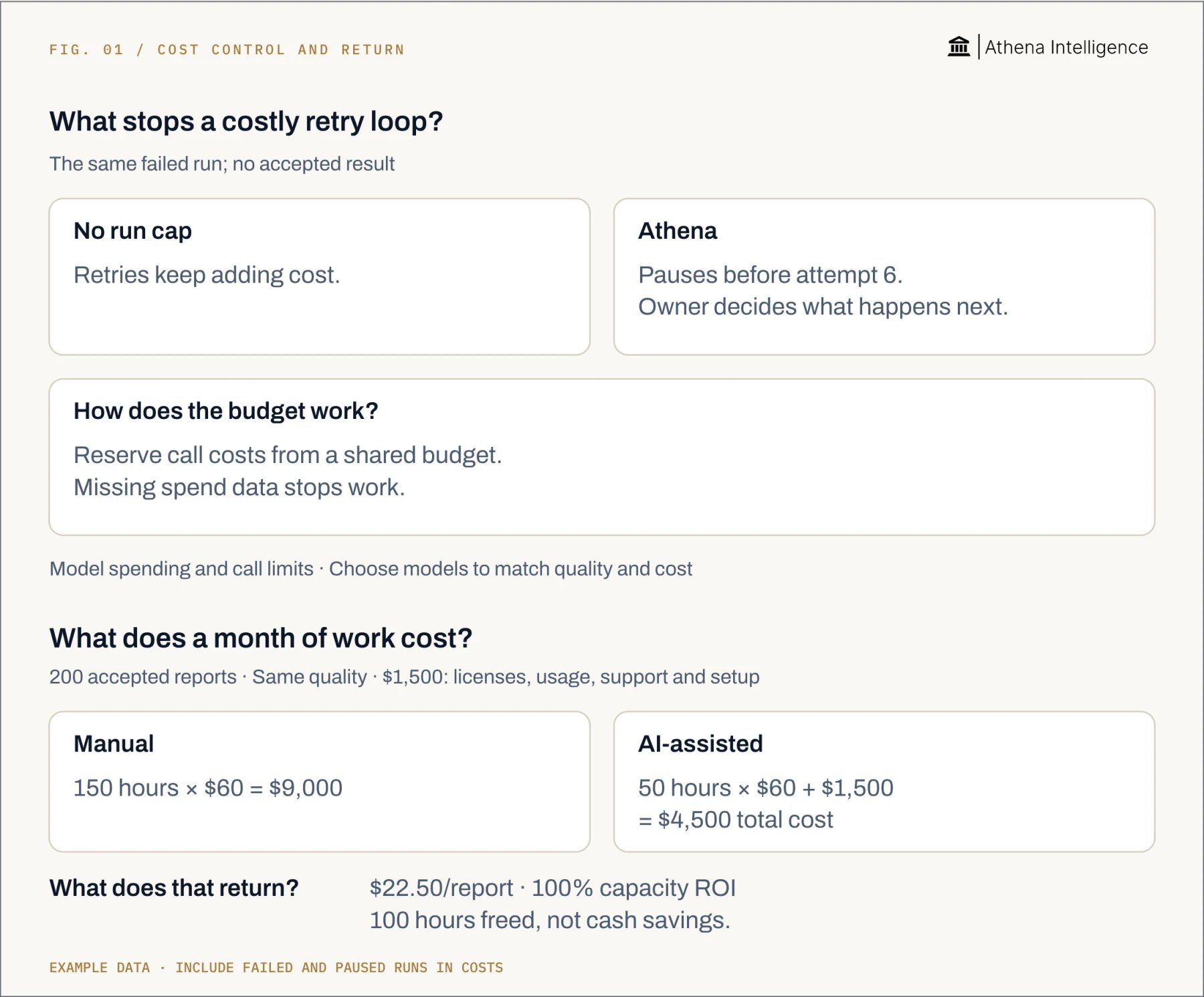
Consider a synthetic monthly example with 200 reports. Manual preparation takes 45 staff minutes each. AI-assisted preparation and review take 15 minutes each at unchanged quality.
At an assumed $60 hourly labor cost, manual work costs `150 × $60 = $9,000`. AI-assisted labor costs `50 × $60 = \$3,000\`.
Add $1,500 for licenses, usage, support, and allocated setup. Total AI workflow cost is $4,500. Assume no other baseline costs or revenue benefit.
If all 200 reports are accepted:
* Cost per report is `$4,500 ÷ 200 = $22.50`, versus \$45 manually.
* Capacity-valued cost reduction is `$9,000 − $4,500 = $4,500`.
* Capacity-based ROI is `$4,500 ÷ $4,500 × 100 = 100%`.
The workflow releases 100 staff hours. Record how the team uses them, and retain baseline samples, reviewed outputs, time records, and acceptance decisions.
Remeasure after changing the model, workflow, or workload. A successful trial needs a measurement period and an owner for the assumptions.
 ## How do chat assistants, copilots, and Athena compare?
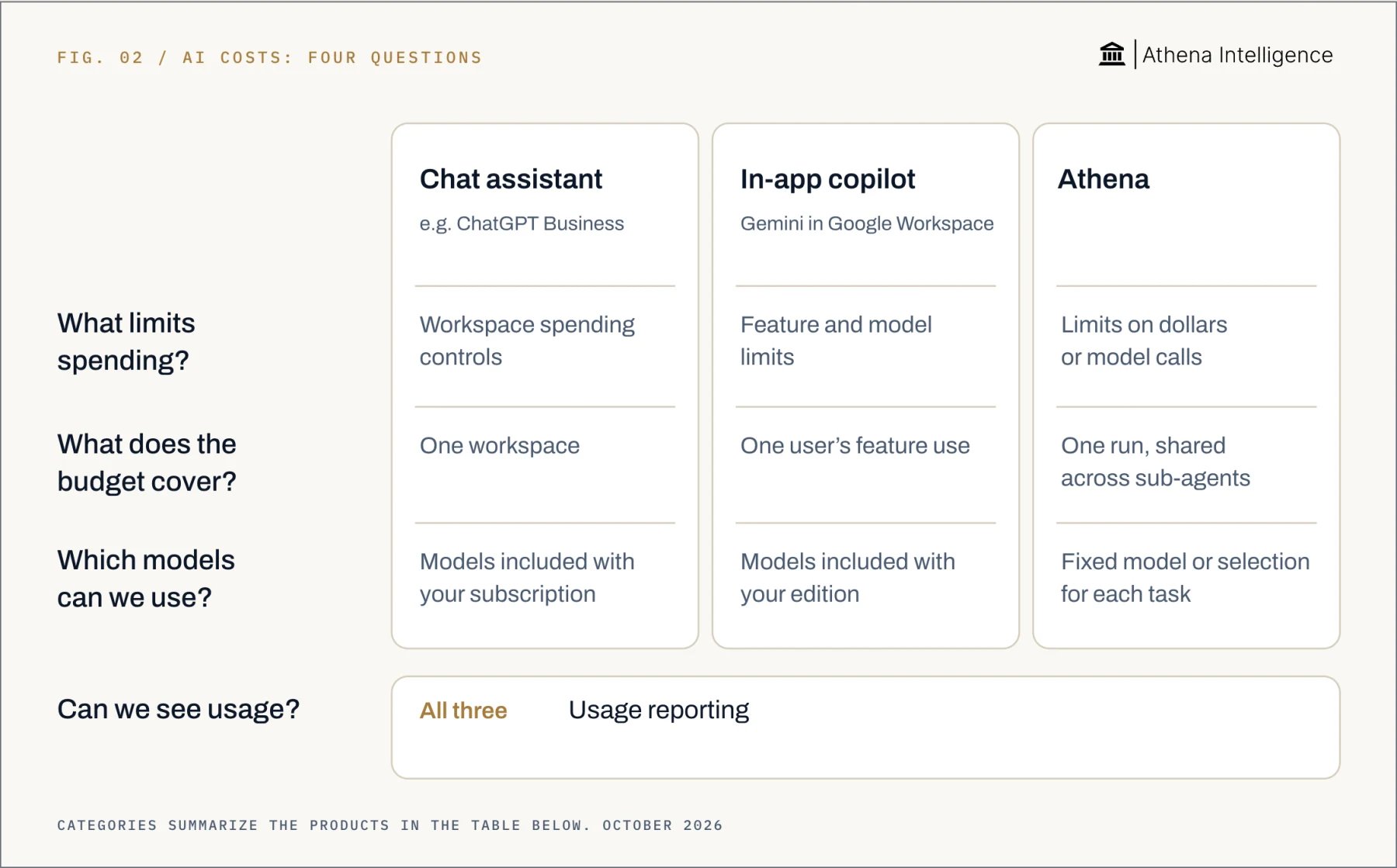
Compare the allowance, stopping behavior, reporting, and model choices for your workflow. Microsoft’s Copilot Studio handles [credit-based agent activity](https://learn.microsoft.com/en-us/microsoft-copilot-studio/requirements-messages-management); Google’s Gemini in Workspace provides AI within office apps.
## How do chat assistants, copilots, and Athena compare?
Compare the allowance, stopping behavior, reporting, and model choices for your workflow. Microsoft’s Copilot Studio handles [credit-based agent activity](https://learn.microsoft.com/en-us/microsoft-copilot-studio/requirements-messages-management); Google’s Gemini in Workspace provides AI within office apps.
 | Cost-control dimension | ChatGPT Business | Microsoft Copilot Studio | Gemini in Google Workspace | Athena |
| - | - | - | - | - |
| Spending boundary | [Workspace spend controls](https://openai.com/business/pricing/). | [Prepaid credit thresholds](https://learn.microsoft.com/en-us/microsoft-copilot-studio/requirements-messages-management). | [Feature and model limits](https://support.google.com/gemini/answer/14620100?hl=en); [user feature allowances](https://knowledge.workspace.google.com/admin/generative-ai/workspace-with-gemini/gemini-for-google-workspace-faq-business). | [Dollar or model-call caps](https://athenaintel.com/product/trust/budgets-governance/). |
| Budget scope | [Workspace spend controls](https://openai.com/business/pricing/). | [Tenant credit capacity](https://learn.microsoft.com/en-us/microsoft-copilot-studio/requirements-messages-management). | [User feature allowances](https://knowledge.workspace.google.com/admin/generative-ai/workspace-with-gemini/gemini-for-google-workspace-faq-business). | [Shared per-run allowance](https://athenaintel.com/product/trust/budgets-governance/). |
| Usage reporting | [OpenAI usage reporting](https://openai.com/business/pricing/). | [Microsoft usage reporting](https://learn.microsoft.com/en-us/microsoft-copilot-studio/requirements-messages-management). | [Google usage reporting](https://knowledge.workspace.google.com/admin/generative-ai/review-gemini-usage-in-your-organization). | [Athena usage reporting](https://athenaintel.com/product/trust/budgets-governance/). |
| Model choice | [Subscription model access](https://openai.com/business/pricing/). | [Primary model selection](https://learn.microsoft.com/en-us/microsoft-copilot-studio/authoring-select-agent-model). | [Edition-based model access](https://workspace.google.com/pricing.html); [Gemini Apps access](https://support.google.com/gemini/answer/14620100?hl=en). | [Pinned or routed models](https://athenaintel.com/product/trust/models/). |
OpenAI provides ChatGPT Business usage reporting, Microsoft provides Copilot Studio usage reporting. Google provides [Gemini usage reporting](https://knowledge.workspace.google.com/admin/generative-ai/review-gemini-usage-in-your-organization), and Athena provides agent usage reporting. Athena combines shared per-run limits with cost views by workflow, agent, user, and project.
Set the allowance when you start an Agent Operating Procedure run through the API. Add `run_budget` to the `/api/v0/aop/execute` or `/api/v0/aop/execute-async` request with `max_cost_usd`, `max_model_calls`, or both.
Before each model call, Athena reserves expected cost against the shared allowance. Parallel agents cannot reserve the same remaining budget twice.
At the cap, Athena stops the run before the next model call and marks it as not succeeded. Work completed so far is saved. To continue, start a new run with a larger `run_budget`.
Athena can [pin a model or route repeated work](https://athenaintel.com/product/trust/models/) to the cheapest model meeting the required output-quality standard. Outputs record which model ran.
Use Athena’s budgets and governance controls and model pinning and routing to plan the trial. Join usage records with staff time and acceptance decisions for the ROI calculation.
## What to plan for
* **Unfinished work:** Athena's cap can leave a job incomplete. Assign an owner to accept partial output or approve more budget.
* **Different stopping rules:** OpenAI’s [alerts leave traffic running](https://developers.openai.com/api/docs/guides/spend-limits); monthly hard API limits can allow slight overages during enforcement delay.
* **Credit thresholds:** Microsoft’s Copilot Studio prepaid custom agents stop at 125% capacity; new agent-flow runs stop at exhaustion. Ongoing work can finish.
* **Included usage:** Microsoft includes qualifying employee-facing Studio usage for authenticated Copilot license holders, subject to conditions and fair usage.
* **Google limits:** Google’s [Workspace AI access can be reduced at limits](https://knowledge.workspace.google.com/admin/generative-ai/workspace-with-gemini/gemini-for-google-workspace-faq-business). Google’s Gemini API account and experimental project caps can allow [delayed-enforcement overages on spending caps](https://ai.google.dev/gemini-api/docs/billing).
* **Budget coverage:** Athena's dollar cap covers model spending; call limits bound calls. Execution stops if its spend tracker is unavailable.
* **Additional charges:** Include tools, storage, and OpenAI’s GPT-5.4 Mini regional-processing uplift of [10% where applicable](https://developers.openai.com/api/docs/pricing).
* **Savings:** Count review, rework, setup, and external services. Released hours become cash savings only when spending falls; avoid double counting benefits.
## Questions teams ask
OpenAI offers custom Enterprise pricing through sales, with credit-based and token-based arrangements. Obtain a quote covering included usage and billing terms.
Microsoft’s enterprise offer lists \$30 per user monthly, paid yearly, plus a qualifying Microsoft 365 license.
Price every call's input, cached input, and output tokens at OpenAI’s model-specific token rates. Include retries in your forecast.
OpenAI’s ChatGPT Business offers workspace spend controls, while Microsoft’s Copilot Studio uses credit capacity and spending rules. Test the stopping behavior with a small failing task.
Athena shares one per-run dollar and model-call allowance across sub-agents.
Start with total cost per accepted outcome against the manual baseline. Report quality, review time, and failure rate alongside it.
[See it work](https://athenaintel.com/demo/)
This documentation is built and hosted on [Mintlify](https://mintlify.com), a developer documentation platform.
| Cost-control dimension | ChatGPT Business | Microsoft Copilot Studio | Gemini in Google Workspace | Athena |
| - | - | - | - | - |
| Spending boundary | [Workspace spend controls](https://openai.com/business/pricing/). | [Prepaid credit thresholds](https://learn.microsoft.com/en-us/microsoft-copilot-studio/requirements-messages-management). | [Feature and model limits](https://support.google.com/gemini/answer/14620100?hl=en); [user feature allowances](https://knowledge.workspace.google.com/admin/generative-ai/workspace-with-gemini/gemini-for-google-workspace-faq-business). | [Dollar or model-call caps](https://athenaintel.com/product/trust/budgets-governance/). |
| Budget scope | [Workspace spend controls](https://openai.com/business/pricing/). | [Tenant credit capacity](https://learn.microsoft.com/en-us/microsoft-copilot-studio/requirements-messages-management). | [User feature allowances](https://knowledge.workspace.google.com/admin/generative-ai/workspace-with-gemini/gemini-for-google-workspace-faq-business). | [Shared per-run allowance](https://athenaintel.com/product/trust/budgets-governance/). |
| Usage reporting | [OpenAI usage reporting](https://openai.com/business/pricing/). | [Microsoft usage reporting](https://learn.microsoft.com/en-us/microsoft-copilot-studio/requirements-messages-management). | [Google usage reporting](https://knowledge.workspace.google.com/admin/generative-ai/review-gemini-usage-in-your-organization). | [Athena usage reporting](https://athenaintel.com/product/trust/budgets-governance/). |
| Model choice | [Subscription model access](https://openai.com/business/pricing/). | [Primary model selection](https://learn.microsoft.com/en-us/microsoft-copilot-studio/authoring-select-agent-model). | [Edition-based model access](https://workspace.google.com/pricing.html); [Gemini Apps access](https://support.google.com/gemini/answer/14620100?hl=en). | [Pinned or routed models](https://athenaintel.com/product/trust/models/). |
OpenAI provides ChatGPT Business usage reporting, Microsoft provides Copilot Studio usage reporting. Google provides [Gemini usage reporting](https://knowledge.workspace.google.com/admin/generative-ai/review-gemini-usage-in-your-organization), and Athena provides agent usage reporting. Athena combines shared per-run limits with cost views by workflow, agent, user, and project.
Set the allowance when you start an Agent Operating Procedure run through the API. Add `run_budget` to the `/api/v0/aop/execute` or `/api/v0/aop/execute-async` request with `max_cost_usd`, `max_model_calls`, or both.
Before each model call, Athena reserves expected cost against the shared allowance. Parallel agents cannot reserve the same remaining budget twice.
At the cap, Athena stops the run before the next model call and marks it as not succeeded. Work completed so far is saved. To continue, start a new run with a larger `run_budget`.
Athena can [pin a model or route repeated work](https://athenaintel.com/product/trust/models/) to the cheapest model meeting the required output-quality standard. Outputs record which model ran.
Use Athena’s budgets and governance controls and model pinning and routing to plan the trial. Join usage records with staff time and acceptance decisions for the ROI calculation.
## What to plan for
* **Unfinished work:** Athena's cap can leave a job incomplete. Assign an owner to accept partial output or approve more budget.
* **Different stopping rules:** OpenAI’s [alerts leave traffic running](https://developers.openai.com/api/docs/guides/spend-limits); monthly hard API limits can allow slight overages during enforcement delay.
* **Credit thresholds:** Microsoft’s Copilot Studio prepaid custom agents stop at 125% capacity; new agent-flow runs stop at exhaustion. Ongoing work can finish.
* **Included usage:** Microsoft includes qualifying employee-facing Studio usage for authenticated Copilot license holders, subject to conditions and fair usage.
* **Google limits:** Google’s [Workspace AI access can be reduced at limits](https://knowledge.workspace.google.com/admin/generative-ai/workspace-with-gemini/gemini-for-google-workspace-faq-business). Google’s Gemini API account and experimental project caps can allow [delayed-enforcement overages on spending caps](https://ai.google.dev/gemini-api/docs/billing).
* **Budget coverage:** Athena's dollar cap covers model spending; call limits bound calls. Execution stops if its spend tracker is unavailable.
* **Additional charges:** Include tools, storage, and OpenAI’s GPT-5.4 Mini regional-processing uplift of [10% where applicable](https://developers.openai.com/api/docs/pricing).
* **Savings:** Count review, rework, setup, and external services. Released hours become cash savings only when spending falls; avoid double counting benefits.
## Questions teams ask
OpenAI offers custom Enterprise pricing through sales, with credit-based and token-based arrangements. Obtain a quote covering included usage and billing terms.
Microsoft’s enterprise offer lists \$30 per user monthly, paid yearly, plus a qualifying Microsoft 365 license.
Price every call's input, cached input, and output tokens at OpenAI’s model-specific token rates. Include retries in your forecast.
OpenAI’s ChatGPT Business offers workspace spend controls, while Microsoft’s Copilot Studio uses credit capacity and spending rules. Test the stopping behavior with a small failing task.
Athena shares one per-run dollar and model-call allowance across sub-agents.
Start with total cost per accepted outcome against the manual baseline. Report quality, review time, and failure rate alongside it.
[See it work](https://athenaintel.com/demo/)
This documentation is built and hosted on [Mintlify](https://mintlify.com), a developer documentation platform.